Water is the foundation for a healthy living environment, yet the pressure on our water system is increasing rapidly. Our activities and those of our partners have an impact on the water balance, water quality and water use in the Netherlands. The limited availability of water hampers potential project developments in the future, and Heijmans takes its responsibility seriously by considering water in everything we do. We are taking a number of actions to limit – and even reduce – our negative impact by reducing drinking water use at our own sites, for example. We have the expertise to improve the quality and quantity of water, and are working closely with our value chain partners in this area. We also actively participate in networks such as Collectief Natuurinclusief Domein Water, De WaterBank and Waterambassade to come up with new insights and innovations.
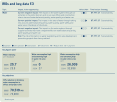
Impacts, risks and opportunities
As part of the reassessment, the previously identified negative impact for water on the upstream value chain and our own operations was split into two separate negative impacts. By considering different water principles in the design, we can also see that we have a positive impact in the downstream value chain.
Furthermore, we also see a dependency on water for carrying out our business operations and see a risk that the availability of water will decline in the future. We have also identified a financial risk in this regard.
Policy
We want to be the sustainable leader on water. Our starting point is that we give back more than we take and leave the environment better than we found it. We use water as a guiding principle in our projects. In doing so, we take into account areas with high water risks and physical water characteristics that adversely affect the environment. These properties relate to the water balance, water quality and the associated safety for the environment. There are also areas that suffer from water stress, where water shortages arise due to high water use and low availability of water at the same time. We want to minimise our negative impact in such areas and increase our positive impact in the future. This is also set out in our ‘Water Matters’ policy, available at rapportage.heijmans.nl. The policy is shared with stakeholders to support dialogue on water-related topics. Our policy is in line with a number of initiatives on the market that are described in more detail under the actions. The policy has been drawn up for the entire value chain, although it is now only being implemented within our own organisation.
Water is the foundation of a healthy living environment. We distinguish between the natural water system and the technical system, which are designed for human needs and safety. The natural system includes rainwater, groundwater and surface water, while the technical system comprises sewerage, hydroengineering structures, wellpoint systems, drinking water supply and process water installations. The different forms of water are interconnected across a range of cycles. To ensure water is handled with care, it is essential to monitor the impact on the entire water cycle. In so doing, we pay attention to water quality, water use, water balance and water safety.
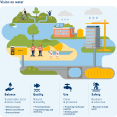
Water use, water balance, water quality and water safety are closely linked to each other. High water use affects the water balance and can lead to water stress, particularly in areas with low availability of water. The amount of water, in turn, has an impact on water quality and safety, while the water quality plays a key role in the health and safety of the environment. Our operations and our value chain allow us to have an impact on public areas and the water system. At the same time, we are dependent on a water system that runs smoothly. Declining availability of water can lead to (financial) risks such as being unable to achieve projects, while such dependency is not only linked to our water use, but also to the water balance and the water quality in the environment. When designing buildings, we aim to have a positive impact on the end use. We do not currently extract or treat water, and are working to increase our understanding of the water footprint in our own operations and the supply chain. Should it transpire that the footprint needs to be substantially restored, we view water extraction as a potential measure to do so. Our policy does not focus on water management, water pollution or sustainable oceans and seas, as these subjects only relate to our activities to a limited extent.
Actions
We use the Ecology, Soil and Water scan (EBW scan) and apply sustainable design principles in creating a balance between ecology, soil and water to determine project-specific actions. We are also involved in networks to explore and implement new water initiatives.
At present, there is still limited insight into the use of resources for strategic implementation and how monitoring is carried out. In the table on the next page, we explain the actions implemented during the past year. The time horizon of such actions is also linked to the duration of a project, and relates to projects started before or in 2025. In terms of classification, each action is linked to a step in the water mitigation ladder, which is a step-by-step plan to minimise negative impacts on nature. We also indicate whether an action was implemented in a water risk area in 2025.
In our own operations, we are still seeking to understand where the greatest water impact can be found. Actions to reduce water use in our operations will be established in the coming years. In 2025, however, we launched a study of water use in the supply chain to gain a better understanding on the impact of our value chain. Among other things, we are researching whether less drinking water can be used when applying concrete and steel and/or whether alternative design choices are possible. This study is still ongoing, and we aim to expand it further in the years ahead in order to formulate appropriate reduction actions.
|
Action |
Explanation |
Mitigation ladder |
Risk area |
Policy link |
Value chain |
|
|
Measurement instruments |
Impact assessment Water Framework Directive |
We conducted an assessment on activities we carry out in projects and identified their impact on water quality. We are looking for appropriate control measures. This was carried out in collaboration with TAUW. |
N/A |
Yes |
Water quality |
Own operations and upstream |
|
Waterbank |
We carried out a residual water scan in a project for the reuse of well water. |
Water recovery and reuse |
Yes |
Water use |
Upstream |
|
|
Water quality assessment framework |
The Water Quality Assessment Framework for Regional Waters enables water managers and initiators to assess in a clear and structured manner whether activities subject to notification and licensing requirements harm water quality, in accordance with the requirements of the European Water Framework Directive (WFD). In 2025, we applied this to two projects: negative effects were mitigated, while recommendations were made to further improve water quality in cases of neutral effects. |
Eliminating negative impact on water quality and improving water quality |
No |
Water quality and water balance |
Own operations |
|
|
Partnerships |
Construction roundtable for drinking water-efficient residential neighbourhoods |
An initiative of the province of Gelderland and drinking water company Vitens to save drinking water in residential developments. This is a public-private partnership in which new methods for saving drinking water are being developed and applied. |
Reducing drinking water consumption |
No |
Water use |
Downstream |
|
'Voice of Water' session |
This year, we started a design workshop in an area development project with the municipality, water board, drinking water company and province, where the 'Voice of Water' was specifically represented. |
N/A |
Yes |
General |
Upstream |
|
|
Internal research |
Internal water standards |
Standards for water problems are being developed within different business streams. We share these in our Heijmans Solutions Platform (HOP) and the product quality knowledge base, among other places. |
N/A |
No |
General |
Own operations and downstream |
|
Opportunities for linking the Water Framework Directive and nature restoration |
In collaboration with residents and clients, we have redesigned a side channel in a dyke reinforcement project, resulting in nature restoration and improved water quality. |
Restoration and regeneration of aquatic ecosystems |
No |
Water quality and water safety |
Downstream |
|
|
Other |
Construction of artificial reef |
As part of a dyke reinforcement project, we constructed an artificial reef and a natural salt marsh. Innovative actions have restored aquatic biodiversity and improved water quality. |
Restoration and regeneration of aquatic ecosystems |
No |
Water quality |
Downstream |
|
Alternative water sources |
We are investigating whether it is possible to use water sources other than drinking water in the production of materials. For example, we are looking into whether surface water can be used in the production of grout and rainwater can be used for mobile concrete plants. |
Reducing drinking water consumption |
No |
Water use |
Upstream |
|
|
Dyke reinforcement |
We have various projects focused on dyke reinforcement. We look at the area where we are working and take appropriate actions. |
N/A |
No |
Water balance, water safety |
Own operations and upstream |
|
|
Redesign of streets |
In some projects, we focus specifically on drainage. For example, we install wadis for storage and purification of runoff road water. |
N/A |
Yes |
Water balance and water safety |
Downstream |
|
|
Mobile water treatment plant |
We have a compact water treatment plant that enables us to clean contaminated groundwater. |
Water recovery and reuse |
Yes |
Water quality |
Own operations and downstream |
|
|
Rainwater collection |
This year, we completed a project in which rainwater is collected and used to flush toilets. This reduces the use of drinking water. |
Reducing drinking water consumption |
No |
Water use |
Downstream |
|
Targets
The current use of drinking water is contributing to the depletion of natural resources. Multiple societal interests are putting pressure on the availability of water. As such, the government and drinking water companies are focusing on reducing water use. In 2022, the cabinet decided that large commercial users must achieve a 20% reduction in drinking water by 2035 compared to 2019. Heijmans is taking an additional step forward here, as our strategic target is to reduce drinking water use within our own operations by 30% by 2030, both at office locations and project locations, compared to 2019 levels.
This year's results show a slight decline compared to the baseline year of 2019. Although water use increased in 2025 compared to 2024, the figures remain stable across the board. We see several possibilities for the limited reduction:
-
Prolonged high temperatures can lead to additional water demand during construction activities; both 2019 and 2025 saw periods of high temperatures.
-
As water-saving actions are not yet applied to every project in a structural manner, water use may be affected by the specific nature of the works.
We will continue to investigate the increase further. The figures for 2025 allow us to focus on the locations with the highest water use and take targeted actions where necessary. We are currently working to increase insights around water use, which may lead to future targets around use in water stress or water risk areas. With regard to water quality, water balance and water safety, we have set ambitions in our policy that are not quantitatively measurable. We do not take ecological thresholds into account in our targets.
|
Material topic |
Target |
Baseline year |
Result 2024 |
Result 2025 |
Policy link |
Value chain |
|
Water use |
By 2030, we aim to reduce drinking water consumption in our office buildings and project locations by 30% compared to the baseline year 2019. |
73,080 m3 |
61,891m3 |
70,519 m3 |
Water use pillar |
Own operations |
|
-15.3% |
-3.5% |
Metrics
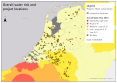
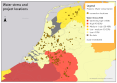
We report our total water consumption in cubic metres (m3). We also provide insight into our water use in risk areas and water stress areas, broken down by risk score. Total water use in 2025 amounted to 70,519 m³ (2024: 61,025 m3). The figure below shows the use in water stress and water risk areas. The result for 2024 has been recalculated compared to the previous annual report. The calculation methodology is explained in the Reporting requirements table.
Water intensity was 25.7 m³ per million euros of revenue (2024: 23.9 m3). In 2025, we started research into the feasibility of future water storage and reuse. We do not store water for use in our current processes and operations, nor do we reuse or recycle (process) water for our own operations.
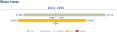
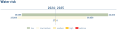
The figure below displays the project locations on a map of the Netherlands. The risk areas shown on the maps below are based on the WRI Aqueduct Water Risk Atlas (version 4.0, 2023).
Reporting requirements
|
Reporting requirements |
KPI definition |
Methodology |
Assumptions |
Limitation |
|
|---|---|---|---|---|---|
|
Target water |
Total water consumption. |
Total water consumption is calculated and extrapolated from periodic statements from water suppliers. The total water consumption per bill is the sum of the water consumption from: 1 January to the end date of the invoice period and the end date of the invoice period up to and including 31 December in the reporting year. |
For the offices where we do not have data on water use, we assume that water use is similar to our other office locations. For this estimate, we have converted usage back to water use in m3 per square metre based on some large and small office locations. |
There are no restrictions on calculating this data point. |
|
|
E3-4 |
28 (a) |
||||
|
As Heijmans receives some of the water bills after the end of the financial year, an estimate has been included for the 2025 financial year for the water bills that have not yet been received at the end of the financial year. This estimate is based on the empirical figures for water bills received in previous years after the end of the financial year. |
|||||
|
In 2025, Heijmans added the baseline year to the statement. The baseline year 2019 was calculated on the basis of the water bills for the 2019 financial year of Heijmans and Van Gisbergen. For Whoon and the other independent entities, an estimate was made for the baseline year based on the ratio of water consumption in 2024 and 2025. |
|||||
|
The comparative figure for 2024 has been adjusted based on the water bills received in the 2025 financial year. |
|||||
|
28 (b) |
Total water consumption in water-risk areas (including areas with high water stress). |
In accordance with DR 28a, total water consumption was determined by loading the data for each location into the GIS programme via an Excel workbook. This contains maps from Aquaduct, namely Water Stress Areas and Water Risk Areas. The usage totals are then added up per risk or stress area per category: Low, Low-Medium, Medium-High, High, Extremely High. |
No assumptions are made for calculating this data point. |
There are no restrictions on calculating this data point. |
|
|
28 (c) |
The total amount of recycled and reused water. |
Water reuse is not an activity of Heijmans, so this figure is zero. |
No assumptions are made for calculating this data point. |
There are no restrictions on calculating this data point. |
|
|
28 (d) |
Stored water. |
Water storage is not an activity carried out by Heijmans, which is why this figure is zero. |
No assumptions are made for calculating this data point. |
There are no restrictions on calculating this data point. |
|
|
29 |
Water intensity. |
Water intensity: [total water use] / [million euro net sales]. The revenue is taken from the 2025 annual accounts. |
No assumptions are made for calculating this data point. |
There are no restrictions on calculating this data point. |
|