Heijmans creates a healthy living environment. This means that we not only build and maintain sustainable infrastructure, buildings and homes, but we also take care of the people who make a contribution to them. In this chapter, we will provide an insight into our own operations and the role of employees within our value chain. We will address issues such as safe and healthy working conditions, diversity and inclusion, equal opportunities and fair labour practices. In addition, we outline how our value chain is structured and how we have further embedded our due diligence approach—covering human rights, including environmental and governance elements—within this value chain. which will show how we take responsibility for people and society, both now and in the future.
People in the value chain
Heijmans' value chain is broad and includes various material flows, products, activities and people. The topics in our sustainability statement return in various parts of this value chain. You can read more about them under . In this chapter, we focus specifically on the impact that may be felt by people in our value chain, from employees at our suppliers to consumers and end users of our products. We distinguish between different groups in the value chain. To ensure clear and consistent terminology is applied, we use the following terms:
-
Own workforce: Our own employees and non-employees. Interns fall outside the scope of our own workforce.
-
Our own employees: Employees with a direct employment contract with Heijmans, including employees working at joint ventures and special purpose vehicles.
-
Non-employees: These employees do not have an employment contract with Heijmans, but work through a party involved in job placements or based on a contract for services. This concerns hired employees such as seconded staff, temporary staff and freelancers. Subcontractors do not fall under this group.
-
Business partners: we work with business partners for various activities, for example in the areas of project management, strategic support, process improvement and the development of sustainable tools. Although these partners are considered as Tier 1 relationships, employees at such partners fall outside the scope of workers in the value chain.
-
Workers in the value chain: A person who performs work within the Heijmans value chain, regardless of the existence or nature of contractual relationships with our company. This group includes contracting parties, (sub-)suppliers, subcontractors, manufacturers of building materials and employees in transport and the extraction of raw materials. In this report, the focus lies mainly on employees who enter building sites. Our goal is to create a better picture of the entire value chain in the future.
-
Consumers and end users: Persons or groups who actually use the products, works and facilities produced by Heijmans or are directly exposed to them in the utilisation phase. This includes residents, visitors, office users, employees and passers-by who use residential and work buildings, infrastructure solutions and public facilities implemented by Heijmans.
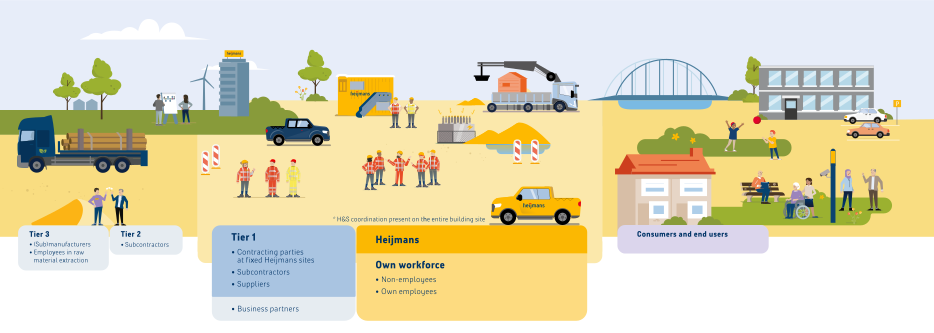
Our business operations are very diverse, which means that the composition of and relationships between people in the value chain can vary significantly from one project to another. The visual below shows what such a collaboration may look like in practice
and explains that our value chain consists of several parties and roles, which together contribute to achieving our projects.
Policy
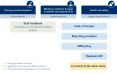
The overview below shows the most important policy documents that apply to both our own workforce as well as workers in the value chain, and which are relevant to consumers and end users. We ensure clear, coherent reporting by describing these policy documents in the Social information chapter. Specific topics such as training and development, terms of employment, equal treatment and opportunities, health and safety are presented in context, allowing us to provide an insight into how Heijmans manages social aspects throughout the entire value chain.
Staff handbook
(including an anti-discrimination policy)
Our staff handbook sets out the agreements that apply between our employees and the employer. It includes guidelines on training, development, equal treatment and more. We also set out what we mean by discrimination and inappropriate behaviour. This ensures we follow the relevant international and national laws and regulations as well as our own procedures for any situations involving such behaviour.
Code of Conduct
Our Code of Conduct sets out how we deal with each other and our partners, subcontractors and suppliers.
Reporting procedure
Affected stakeholders, including our own workforce and employees of subcontractors and partners, can report misconduct to Heijmans using the existing reporting procedure for inappropriate behaviour, integrity and misconduct. The Dutch Whistleblower Protection Act is also included in the reporting procedure.
GO! policy
Heijmans' safety policy is firmly anchored in a range of documents and procedures and applies to all persons who fall under the health and safety coordination. The GO! policy consists of the GO! Compass, a concise summary of workplace agreements, and the GO! strategy, which sets out our safety targets and starting principles. A detailed explanation of our safety policy can be found in the chapter 'Our foundation - Safety' of the Management Report.
Socially responsible business
This policy sets out how Heijmans conducts business with integrity and ensures compliance with human rights, including tax transparency, fair competition and the prevention of bribery and corruption. The policy is drawn up in line with international guidelines such as the UN Guiding Principles on Business and Human Rights, the OECD guidelines, ILO conventions and the Universal Declaration of Human Rights. This underlines our focus on doing business with integrity and transparency throughout the value chain as a whole.
In control of the value chain
'In control of the value chain' describes how we work towards better conditions in the value chain using the principles of 'insight', 'engagement' and 'policy'. It sets out the actions and resources we use to arrive at a desired situation and prevent negative impacts on our value chain.
Due diligence
In 2025, Heijmans further strengthened its commitment to corporate social responsibility. The human rights policy has been updated and integrated into the broader Heijmans Corporate Social Responsibility policy. This policy provides an overarching framework that guides our actions and covers subjects such as safety, integrity, the environment, value chain responsibility and respect for human rights.
Policy and governance
Corporate social responsibility is firmly embedded in Heijmans' governance structure. The Executive Board bears ultimate responsibility, supported by a multidisciplinary steering committee and the Risk Office. The policy applies to our own workforce, suppliers and subcontractors and is reviewed and updated on a regular basis.
Risk analysis
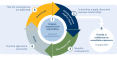
The due diligence process consists of six steps:
In 2025, the risk analysis has been further integrated with ESG-related risks, with extra attention being paid to operational impacts and opportunities. The main risks have been identified in the areas of work, safety, the environment and ethical business conduct. Examples include exceeding working hours, social insecurity, unequal treatment, unsafe working conditions, environmental impact and the risk of tax evasion and corruption.
Actions and monitoring
Heijmans takes targeted actions to end, avoid or limit risks. In terms of work and social safety, initiatives such as Diversity Day, training managers in how to hold open, safe conversations with our own workforce, and specific actions to ensure equal pay and opportunities have been launched. In the area of safety, GO! has been further integrated, while safety discussions and audits have become a structural part of our business operations. The procurement policy and supplier management have been refined, with an emphasis placed on certified materials and suppliers.
The effectiveness of actions is monitored through quantitative and qualitative indicators, such as the number of incidents, complaints, accidents and the degree of compliance with safety and environmental standards. Stakeholder engagement is ensured through regular discussions, engagement surveys and a low-threshold reporting system regarding misconduct.
Transparency and remedial actions
Transparency is key, and stakeholders are informed of policies, risks, actions and results through a range of channels. Clear procedures are in place for remedial actions, including a whistleblowing system and a compliance officer to log and follow up on reports. Each report is investigated with care and, where necessary, appropriate actions will be taken to mitigate negative consequences and prevent a recurrence of such incidents.
Results and goals
The risk of human rights violations is deemed to be low, partly because Heijmans operates in the Netherlands and almost all suppliers are from Europe. Nevertheless, continuous improvement remains the underlying principle. In 2025, steps were taken to tackle pay inequality, improve diversity and inclusion, and further develop monitoring and stakeholder dialogue. The goal is to further expand the scope of our due diligence process, with greater attention paid to Tier 2 suppliers (suppliers or partners that supply products or services to Tier 1 partners; they are one step further down the value chain and have no direct relationship with Heijmans), Tier 3 suppliers (suppliers or partners that supply products or services to Tier 2 partners; these are parties that are even further along the value chain and indirectly contribute to our products or services) and input from external stakeholders.
For more details, please refer to the full reports “Heijmans Responsible Business” and “Heijmans Due Diligence Report 2025”, available via our website rapportage.heijmans.nl.
In 2025, we identified no significant risks in the area of human rights violations, including forced labour or child labour. No additional mitigating actions were needed within our own workforce or among Tier 1 partners. We did not receive any signs or reports of potential human rights violations during the reporting year from within our own workforce, among workers in the value chain or among consumers and end users. Furthermore, no fines, penalties or damages related to serious incidents in this area were imposed in 2025.