In 2025, Heijmans further realised its ambition to play a leading role in achieving solutions for the major challenges in society facing the Netherlands. These challenges – from the housing market and accessibility to the energy transition, water issues, climate change and a coming labour shortage – require integrated, scalable and future-proof solutions.
As creators of a healthy living environment, we take the lead, together with our value chain partners, on a regular basis. Through our 'Together towards 2030' business strategy, our 'Together, it's possible' promise and the financial targets for 2027, we chart a clear course in which social responsibility and financial performance go hand in hand. We achieve this by actively working with partners both within and outside our value chain. This course outlines in specific terms how we want to leave places better than we find them, and how we turn complex tasks into feasible solutions. We can only achieve this thanks to the commitment of almost 6,000 employees who contribute every day to a pleasant, more sustainable and safer living environment.
Five strategic pillars
Through our 'Together towards 2030' strategy, we are giving further direction to our ambition to tackle the complex challenges of the built environment as a sustainable leader. We are doing this based on five strategic pillars: Well-being, Sustainability, Connection, Producibility and Team. Each pillar has a specific focus: Well-being and Sustainability describe WHAT we do to achieve a healthy living environment; Connection and Producibility describe HOW we increase our impact to achieve this; and Team describes WHO we do this with. We have formulated twelve non-financial ‘bold statements’ to support the five pillars. These are challenging ambitions that give us the perspective to set goals for the future.
Embedding in the organisation
In 2025, our 'Together towards 2030' strategy focused on the coherence between the strategic pillars and how they come together to guide our business innovation. We grouped strategic initiatives into integrated, feasible solutions for societal challenges. Examples include building houses in a factory with wood as a sustainable alternative, the acceleration, expansion and sustainability of the energy grid through standardisation and modular construction of high-voltage installations, and data-driven maintenance of infrastructure supported by the use of AI and digital technology. These solutions require collaboration throughout the value chain, smart processes and producibility in execution, with end users at the heart of everything we do. We implement Heijmans' strategic route as follows: sustainable, innovative, scalable and embedded in the environment.
The anchoring of CSRD obligations also contributes to this integrated approach and allows us to guide the impact. In 2027, we will assess whether we are on track to achieve our goals for 2030 and where further acceleration is needed.

Power of Innovation
Achieving Heijmans' strategic goals requires innovations and targeted breakthroughs. That's why, in 2025, we developed the Power of Innovation, as the standard working method within Heijmans for strategic innovation. We will use the Power of Innovation to increase our resilience in a rapidly changing world, and therefore improve our role as a sustainable leader.
The Power of Innovation is a phased process that provides support when working on innovation. We always start by focusing on the right issue and take a conscious approach by looking from the outside in. We arrive at clearly defined initiatives in collaboration with others – internally between employees and externally with (knowledge) partners, designers and start-ups. These initiatives are developed through co-creation and rapid development loops to find tangible solutions. They are then carefully implemented and embedded in practice. Innovation is only successful if solutions are actually adopted and the intended benefits are achieved. Paying attention to adoption and impact is therefore a key part of the working method.
To support the Power of Innovation, Heijmans has established both physical and digital facilities to strengthen collaboration and innovation. The Hive is the central meeting point and is an inspiring environment for people to meet, collaborate and connect with each other and various initiatives. Inspiration sessions, co-creation meetings and experience sessions allow us to bring knowledge and ideas to the table both within and outside of the organisation.
The process is further supported by the 'Stronger Together' platform, which was introduced in Connecting in 2025. The platform offers colleagues the opportunity to contribute ideas and solutions and track the progress of strategic initiatives. In 2026, Heijmans will further expand the phased approach of the Power of Innovation and deploy the 'Stronger Together' platform more widely.
How we create impact
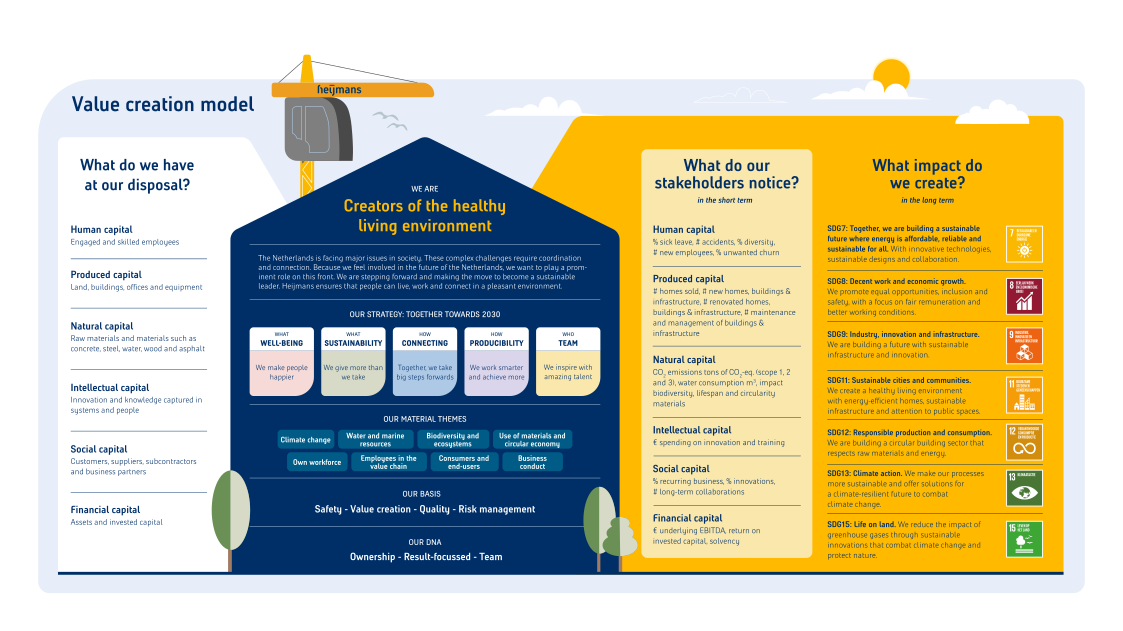
We want to make a positive contribution to society as a whole. Our value creation model provides insight into how we use raw materials and other forms of capital to add sustainable, long-term value through the production of goods and services. Our value creation model can be interpreted as follows:
Business model and strategy
Our primary focus lies in the implementation of our mission 'Creators of the healthy living environment'. We are putting this into practice by achieving our strategy. Furthermore, we will do so in line with our DNA: ownership, results-focused and teamwork. We also take into account several key trends and developments that affect our business model, such as the energy transition, the labour market, and the demand for mobility and housing. In line with the CSRD reporting requirements, Heijmans carried out a reassessment of the double materiality analysis in 2025. This reassessment established that the following eight material topics are of great importance to Heijmans: (1) climate change, (2) water and marine resources, (3) biodiversity and ecosystems, (4) material use and circular economy, (5) own workforce, (6) workers in the value chain, (7) consumers and end users, and (8) business conduct. These topics are in line with our strategy and business operations.
Input
The input from our value creation model consists of everything we need to start creating value. This ranges from the buildings we occupy to the financial resources and the brainpower and manpower we need to realise our products and services.
Output
The output consists of our (financial) results, our specific products and services. This includes obvious products such as our homes, buildings and roads, as well as service and maintenance activities. But it also includes less tangible contributions, such as knowledge development in the sector and strengthening the value chain as a whole.
Impact
We not only want our work to add value today, but also have a positive, lasting impact on society. Our strategy is fully embedded in our business operations, meaning our work contributes to solving issues in society. We make this impact visible by linking our contribution to the internationally recognised Sustainable Development Goals (SDGs) set by the United Nations.
In 2025, we conducted an analysis of our impact on the SDGs. In doing so, we took a qualitative approach to the actual impact we have, which could be positive or negative. We assessed our own operations as well as the impacts of our value chain on the various SDGs, and linked the results of the analysis to the ambition level of our strategy as well as the extent to which the SDG themes are integrated into our day-to-day work. The results are shown in the enclosed visual.
In addition, we have prepared a separate SDG report [available at rapportage.heijmans.nl], in which we further elaborate on these impacts. We also consider it important to make our impact measurable. As such, we have explicitly linked the non-financial KPIs, including data resulting from the CSRD reporting, to the SDGs. In the years ahead, we will investigate how we can further integrate the SDGs into our sustainability statement.