At Heijmans, we always look at things from the user's point of view. That is why we do what we do. Our efforts allow us to create environments that are healthy, safe and attractive. We are not satisfied until users actually notice improvements, so our work must contribute to people's well-being.

Physical design
The social environment in which Heijmans operates is changing rapidly. Developments such as inequality of opportunity, transport poverty and heat stress have a direct impact on how people experience well-being. We want to use our projects to contribute to a safe, healthy and attractive living environment.
At Heijmans, we have extensive experience of interventions that contribute to users' well-being in the areas of living, working and connecting. In 2025, we focused on developing a well-being policy framework that spanned the organisation. In doing so, we are working on a method – based on theory of change – that provides insight into the current situation, offers direction to improve well-being in a targeted manner, and enables the effects to be monitored. This approach helps us to contribute to physical, mental and social well-being in a more targeted manner and forms the basis for a recognisable quality standard that we are trialling in area developments and gradually want to roll out further. More information can be found in the Consumers and end users chapter.
We seek to work with knowledge partners with a view to developing an effective, future-proof approach. TNO and the Data and Knowledge Hub Healthy Urban Living (DKH), in which the University of Utrecht, the University of Applied Sciences Utrecht, the University Medical Centre Utrecht, RIVM and more work together, are involved in creating our Well-being methodology. Their scientific insights and tools increase the quality, usefulness and legitimacy of our approach. We also believe it is important that the knowledge acquired is widely accessible, so it can also be used outside of Heijmans and updated further.
From analysis to intervention
Well-being is highly dependent on the situation at any given time. As such, our methodical approach starts with conducting an impact scan, which begins with a baseline and maps out the opportunities and challenges in an area. In practice, we see that issues such as poor mobility, inequality of opportunity and loneliness come up on a regular basis. The insights from the scan form the basis for our area development and help us to identify, together with local stakeholders, users and partners, targeted interventions that can enhance residents' well-being.
We use public data, local policies and reports for the analysis. In addition, we consult a number of 'local heroes', such as stakeholders, residents and users, to gain an insight into the subjective experience felt in the living environment. These combined insights allow us to draw up targets for the intended impact. We can then determine which interventions contribute to the well-being of users, such as when it comes to socialisation and mobility. In 2025, Heijmans carried out impact scans in Hellevoetsluis, IJsselstein, Zutphen and Beverwijk.
Many existing city districts include large amounts of stone buildings, with little greenery and water and limited space for socialisation and mobility. In ever warmer summers, these neighbourhoods are particularly vulnerable to heat stress, affecting residents' health and quality of life. When redeveloping such neighbourhoods, Heijmans therefore focuses on adaptive measures such as adding more green areas and water in a targeted manner, creating space for water collection and shade, and redesigning public areas to include shaded areas and create cooling. Green areas also contribute to better air quality by filtering fine dust and other air pollutants, and are particularly important in densely populated and high-traffic areas. A greener, attractive living environment also invites people to be increasingly mobile and meet up. One such example is the Podium project in Amersfoort. In this neighbourhood, two green spaces form an important part of the design. These include a continuous green area through the neighbourhood and a landscaped park with space for water storage, ecology and natural play elements. Nature is also an integral part of the design in the De Kuil project in Rotterdam, as this inner-city area has been redeveloped into a green urban district. Trees in strategic locations provide shade, while water misting in the courtyard provides cooling on hot days. Nesting boxes for birds, butterflies, bees and bats are also integrated into the building. Roofs are greener with the planting of sedum, and land boundaries also contain greenery. A rainwater collection system has also been integrated into the district.
Research
Heijmans actively researches the effects of interventions together with external knowledge partners. As an example, the University of Utrecht and Heijmans have researched which factors promote social cohesion and well-being in new-build districts. Research conducted in Maanwijk (Leusden) and De Hooge Riet (Ermelo), among others, shows that residents who are involved in the design and management of their living environment actually have more contact with neighbours and form a community. The studies also show what works less well. Facilities designed and furnished in full by the developer, such as the neighbourhood barn in Maanwijk, are used less than expected. Future residents are not actively involved and have not been able to contribute, which has resulted in a lack of ownership. These insights allow us to increase our knowledge of what really works and helps us to better align interventions to the situation in question. Heijmans and the University of Utrecht will continue to monitor developments in these districts.
In 2025, Heijmans also entered into a partnership with Tallinn University of Technology (TalTech) in Estonia. This partnership focuses on validating a research method, known as the Well-being score, with which the well-being of residents and visitors in a spatial environment can be measured in an objective manner. Neurological, physiological and psychological research is combined with spatial designs in virtual reality to this end. This allows us to understand the effect of design choices on well-being before they are put into practice. The validation study will be conducted in the first half of 2026.
An inner-city transformation
Case study – Zuidwest district, The Hague
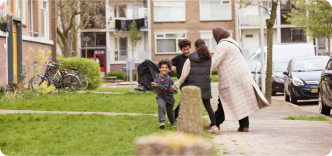
In the Zuidwest district of The Hague, Heijmans is partnering with the housing corporation Staedion and the municipality of The Hague to update the Dreven, Gaarden and Zichten neighbourhoods. The redevelopment includes around 5,500 new homes and focuses on improving residents' well-being and quality of life.
The need for change has long been felt in the district, as the condition of the housing stock, the living environment and the lack of future prospects meant the area needed a boost. Together, we work to create a healthy, safe and social neighbourhood, with more space for green areas, clean air, safe routes and facilities to encourage socialisation. This approach will allow current and future residents to move forward together.
In 2025, this area-based approach gained additional significance with the launch of BRUIS, a ten-year programme in which residents and a range of partners, including Longfonds, come together in Zuidwest to work on initiatives promoting physical and mental health. This will help to create a healthy environment in which children and young people can grow up, even during the long-term modernisation project.
Healthy indoor climate
People spend up to 90% of their time indoors, a large part of which is in their own home (source: RIVM). Heijmans develops concepts to guarantee a healthy indoor climate, such as smart ventilation systems for fresh air and optimum comfort. In the design phase, we always factor in accessibility, lots of daylight, sensory well-being and ease of use.
As creators of the healthy living environment, we also act as a motivator – and that's why we are also a co-founder of Stichting Gezond Binnen (new window). In 2025, the foundation presented its manifesto on the topic of 'Everyone has the right to a healthy indoor climate!' to the Minister of Health, Welfare and Sport, and we are calling on the sector and the government to make sure health in homes and buildings is firmly on the agenda.
In 2025, Heijmans took further steps in developing the Gezond Binnen label, under the auspices of Stichting Gezond Binnen. The label focuses on measurable factors such as air exchange, daylight entry, temperature comfort and sound insulation, and provides some insight into the health of indoor spaces for residents. Heijmans translated the Programme of Requirements into a tool that can be used in practice to lay the foundations for a well-supported, market-driven label that will be further developed in 2026. The label helps clients and residents to assess and improve the quality of their indoor climate from an objective viewpoint.
Use of materials
The use of healthy and sustainable building materials is essential for a healthy living environment. That is why we constantly evaluate our choice of materials. We test techniques such as biobased construction for their impact on the indoor climate, which promotes a feeling of well-being. Materials such as timber and hemp fibre combine functional benefits with a positive sensory experience. Timber creates a warm, natural look, while hemp fibre used as an insulating material helps create a comfortable indoor climate. Thanks to their sustainable and attractive properties, these materials promote both the well-being of residents and the sustainability of our projects.
We are also exploring new biobased materials and innovations. One such example is mycelium, the root-like structure of fungi. This natural material offers options for a wide range of applications, such as facade systems, ceilings and interior walls. In 2025, mycelium was used in the renovation of the national monument at Bezuidenhoutseweg 73 in The Hague. Together with the Dutch Central Government Real Estate Agency, Heijmans transformed the property into a healthy and future-proof working environment, paying attention to daylight, greenery, acoustic comfort and the use of biobased materials such as mycelium. The project demonstrates that well-being, together with sustainability, can be successfully integrated into existing buildings.
A material health scan was developed within Living and Working in 2025. This scan allows us to map out which materials can be improved in projects and home products based on the presence of specific substances. We conduct research into healthier alternatives where possible, ensuring we contribute to the health of everyone involved in our projects – from employees and subcontractors to end users.
Well-being during our work
Our projects have an impact on the environment and can cause short-term nuisance or inconvenience, such as a loss of space for residents, road users, companies and employees in offices. Nevertheless, we strive to reduce disruption in such situations and ensure people feel seen and heard. That starts with how we organise and carry out work, the commitment of our environment managers and the way we stay in touch with the people who are directly affected by the disruption.
Environmentally friendly techniques
At Heijmans, we start thinking about solutions and facilities that limit inconvenience during construction right at the start of a project, in the design phase. Our project teams and environment managers, for example, talk to clients if a connection is to be disrupted on a temporary basis. In such cases, we can often offer a suitable solution. One such example is the large-scale renovation of Spijkenisserbrug, when the bridge was closed for several weekends. A ferry was deployed in order to mitigate the impact and maintain accessibility for slow-moving traffic. Heijmans employees were present to support travellers, including those with reduced mobility, with boarding and disembarking.
We use environmentally friendly techniques in construction projects to limit the impact on the environment, such as the use of electric equipment, SoSEAL (an innovative, natural soil technique) for dyke reinforcements and mobile noise barriers during pile driving. In close consultation with local residents and other stakeholders, we organise our construction process in such a way as to minimise disruption to the surrounding area. We know from experience that this not only contributes to people's well-being during our work, but also improves the quality of the solutions we realise.
In 2025, we deliberately opted for an additional policy measure to further reduce environmental nuisance. As such, from 2026 we are working towards no longer pile driving foundations in inner-city areas, but instead drilling them where possible. This will significantly reduce noise and vibrations, which in turn will contribute to the well-being of surrounding residents and our employees. Pile driving may not be able to be avoided in exceptional cases; we will always take additional measures to control noise and disruption in such situations.
Environmental management
Heijmans attaches great importance to listening to and involving the parties in the environment, residents and users. Active involvement plays a role in social support and the well-being of all stakeholders. That is why we encourage and facilitate participation in our projects, from infrastructure to area development.
In 2025, we took further steps with 'Environmental Management 2.0', which has active engagement at its core. We work with three levels of participation: informing, involving and co-determination. We develop a customised approach for each project that is tailored to the specific situation and requirements before, during and after construction. By communicating in clear, understandable language and using user journeys to structurally map out wishes and concerns, we strengthen engagement and focus on well-being.
The Heijmans BouwApp construction app
We recognise that our work may cause short-term disruption, and therefore attach great importance to staying in touch with the surrounding environment. As part of our environmental management, we are increasingly using the BouwApp construction app to provide local residents and end users with up-to-date information on work and measures to reduce disruption, and to give the residents and end users the opportunity to provide direct feedback. The BouwApp has been used in a range of projects, including at Jan Willem Frisolaan 3 in The Hague, an inner-city project in a very compact environment that is surrounded by existing buildings. Communication with the surrounding environment is therefore essential. The BouwApp allows us to keep local residents informed directly about work, planning, safety and potential disruption, while they can ask questions and give feedback.
In 2025, we measured satisfaction with our environmental communications for the first time using the BouwApp. A survey was conducted for the projects in which we use the BouwApp and where Heijmans is responsible for environmental communications. Satisfaction and appreciation were measured across a total of 26 projects. 76% of respondents gave a score of eight or higher on average. We also received valuable qualitative feedback. The insights from these measurements help us to improve our communication and way of working on an ongoing basis.
Renovation projects
Renovation projects always require a careful approach. We prefer to give residents the opportunity to continue living in their homes during a renovation project. We involve them extensively in the preparation, execution and completion of the work, and strive to minimise inconvenience. The resident coach plays an important role in this process and provides personal support throughout the entire journey. Tools we use in this process are the BouwApp construction app and the system of green and red 'emoticon' stickers that residents can put in their windows to express their satisfaction or concerns about the work. The resident coach will then call to talk to them and look for solutions. This allows us to stay in touch with residents and anticipate issues quickly and effectively. This in turn contributes to a smooth execution, resulting in lasting improvements in living comfort and quality of life.