Heijmans' activities have short- and long-term impacts on our living environment. With that in mind, we are working to increase our positive contribution and to limit and reduce adverse effects. We use sustainable solutions and working methods, actively contributing to a better climate, more biodiversity and a good water balance. We are gradually making the transition to circular working methods in close collaboration with all the links in our value chain. We are convinced that this will help to create a sustainable, liveable future.

Climate
The effects of climate change are becoming increasingly visible and tangible. It is vital that we become climate-neutral and take concrete steps in that direction. That is no easy task, but it is a necessary one. That is why we consciously set the bar high when it comes to our climate targets. Heijmans is on a clear path to achieve net zero in 2040.
Moving towards 2030:
-
We aim to reduce our direct emissions (Scope 1 and 2) by 100% by 2030 compared to 2019, our baseline year. This means that we reduce our direct emissions to zero. We will reduce these emissions using sustainable measures applied to our vehicle fleet, equipment, offices and building sites.
-
Our goal is to reduce absolute Scope 3 emissions by at least 50% by 2030 compared to 2019. In order to achieve this, we are implementing a wide range of measures and initiatives aimed at all parts of the value chain emissions. The focus lies on two main subjects: the sustainable use of resources (upstream) and energy-neutral buildings (downstream).
Towards net zero by 2040:
-
By 2040, Heijmans wants to build and work in a manner that is fully climate-neutral. To that end, Heijmans wants to achieve net zero greenhouse gas emissions across its entire value chain.
Heijmans reports on the climate targets and their progress in more detail in the Climate chapter in the Sustainability Statement.
Sustainable use of resources
Heijmans strives to use raw materials and other materials as efficiently as possible, and to reuse them whenever possible. This requires close cooperation with suppliers and other partners in the value chain. Only by acting together will we be able to realise our climate targets for Scope 3 emissions.
We go right back to the drawing board to start the process. During the design stage, we identify which materials have the greatest environmental impact and optimise the use of materials under the principle of the less, the better. We then choose alternatives with a lower impact, such as wood applications or other biobased materials. In the case of materials that exhibit relatively high greenhouse gas emissions, such as concrete, asphalt and steel, we develop specific solutions in and together with the value chain to reduce such emissions. We also extend the lifecycle of existing structures through targeted management and maintenance, which means we preserve value and material potential.
Concrete chain
The use of cement makes concrete one of the most used and CO2e-intensive materials in the construction sector. The sustainability of concrete requires collaboration throughout the entire chain, from clients to suppliers. Heijmans is an active participant in the Betonakkoord, a national partnership between clients, construction companies, producers and knowledge institutions to further set out in writing the raw materials agreement for concrete. In this partnership, we are working on innovations and agreements that contribute to reducing greenhouse gas emissions in the concrete chain.
In June 2025, over seventy-five representatives of prefabricated concrete suppliers met at Heijmans in Rosmalen to discuss the joint need of four large construction companies for more sustainable prefabricated concrete to meet the new, stricter CO2e threshold values set together with clients. The Betonakkoord also includes target values: ambitious guidelines that offer direction for ensuring (prefabricated) concrete is increasingly sustainable. We want to move towards these target values together with market participants, and several innovative companies presented their solutions to further reduce CO2e emissions from prefabricated concrete. This initiative emphasises that a joint chain approach is essential in accelerating the transition to more sustainable prefabricated concrete.
Asphalt
Another important step in the reduction of our Scope 3 emissions is the construction of a new asphalt plant. The Asfalt Centrale Lage Weide (ACLW) is an initiative of AsfaltNu. Heijmans holds a 50% shareholding in AsfaltNu. Construction started in 2025 and ACLW is expected to be fully operational in 2026. Innovative techniques will ensure that production is low-emission and odour-free. In addition, the plant enables fully circular asphalt to be manufactured, depending on project-specific customer requirements. ACLW will recycle old asphalt and reuse it. The plant will be able to produce asphalt at a much lower temperature, which will be expected to reduce CO2e emissions by more than 50% compared with the current standard.
Circular applications
In 2025, we conducted an impact analysis on our four largest material flows (asphalt, concrete, steel and wood) to better map out circularity. Circularity makes a direct contribution to reducing CO2e emissions. As such, we took further steps in 2025 towards circular savings, particularly in concrete and steel, by putting innovative solutions into practice. One such example includes starting the construction of the Physics building for the Faculty of Applied Sciences on Campus Zuid at Delft University of Technology as part of the Physics construction consortium. The construction consortium is creating an innovative, energy-efficient research building in this project. The Physics building will be built using recycled concrete from the former Logistics and Environment building that was located on the same site. This process, known as concrete harvesting, saves raw materials, reduces CO2e emissions and extends the lifecycle of materials. 70% of the concrete used contains circular raw materials, which means Physics is a pioneer in the area of circular construction in the Netherlands.
Another important step involved beginning the renovations of De Nieuwe Post in Arnhem, and making the building more sustainable. More than half of the materials being used will be reused or biobased, some of which are even being harvested from the existing building itself. Materials donated from another project are also being used.
A specific example of circular working is the pilot project for the reuse and traceability of materials at Schiphol. Between October 2024 and March 2025, we and our partners reused more than 340 materials that were stored in the Freightway warehouse. These materials were provided with a material passport and QR code with geolocation details via an Excess Materials Exchange (EME) digital platform to ensure the materials could be traced and reused easily within the terminal.
Biobased materials
To make our operations even more sustainable, we have committed to the use of biobased materials, such as wood and cellulose in the Horizon concept timber-framed houses. Heijmans also expanded its hemp fibre cultivation from 6.5 hectares to 23.5 hectares in 2025. As part of the 'from our own country to our own premises' programme, in collaboration with GreenInclusive, we have started to grow, process and use hemp fibre as a sustainable alternative to traditional insulation materials. This material offers several advantages: it reduces greenhouse gas emissions during construction, improves the indoor climate thanks to its moisture- and temperature-regulating properties, and its cultivation requires no chemical pesticides or fertilisers. Heijmans will use these end products to insulate homes in the Thedamaborg project in Nietap (Drenthe). Heijmans is also renovating seventy-one rental apartments in Kalsdonk Roosendaal together with the housing corporation Alwel. The pitched roofs are insulated with wheat straw, a 100% natural by-product from agriculture that reduces the environmental footprint and makes homes more comfortable and energy efficient.
Energy-neutral buildings
Achieving energy-neutral buildings represents an important part of our contribution to increasing the sustainability of the built environment. We focus on minimising energy use and using renewable energy, while grid congestion is an ever-increasing challenge. That is why we develop smart solutions such as battery storage and integrated energy systems.
In residential construction, Heijmans applies the non-statutory standard that BENG 2=0 must be achieved for all houses. Our goal is to achieve this for our apartment concept by 2030 at the latest. BENG 2=0 will become the standard for all apartments that we sell in six-floor buildings from 2026.
We combine high-quality insulation with the use of heat pumps, solar panels and more. We are also committed to making buildings gas-free and energy-neutral in non-residential buildings. We look not only at energy systems and installations, but also at the buildings' insulating shell, shape and orientation.
Although infrastructure properties are less energy-intensive than residential or non-residential buildings, we also pay close attention to reducing energy consumption. We do so by using energy-efficient lighting, optimising tunnel installations and more.
Smart and sustainable
Case study: Provinciehuis Overijssel
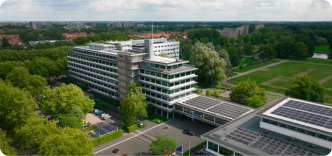
Together with the Province of Overijssel, Heijmans is working to further improve the sustainability of the provincial government building in Zwolle. We are implementing step-by-step improvements based on the client's sustainable goals. Since 2023, the building has been fully gas-free thanks to structural and technical modifications, including triple glazing, solar panels and two high-temperature heat pumps using a natural refrigerant. In 2025, preparations were made to enable the collection of rainwater from 2026 for flushing toilets, resulting in significant savings in drinking water. Finally, the building will be fitted with energy-efficient LED lighting.
The building can also be managed more efficiently using a smart building management system. More than two thousand sensors measure temperature, light, humidity and occupancy levels to allow the lighting and indoor climate to be controlled per zone and faults to be detected more quickly for user comfort and energy savings for the province.
The sustainability of non-residential buildings represents a huge societal challenge. The collaboration with the Province of Overijssel shows how joint ambitions can lead to tangible results, and what we learn here can also be applied to other clients and buildings.
Emission-free transport and equipment
We want to minimise our emissions and reduce our total ecological footprint in our operations. We will do so by taking specific measures in the areas of transport and equipment. Emission-free working is an essential part of our journey towards 2030, as we strive to be fully CO2e-neutral for our own emissions (Scope 1 and Scope 2) and aim to reduce third-party emissions (Scope 3) by 50%.
In late 2025, Heijmans phased out the last fuel-powered cars with yellow number plates (excluding recent acquisitions), which represents an important step in the electrification of our lease car fleet. That means the thousands of lease cars in Heijmans' fleet are now electric, following a transition that lasted six years. In addition, 40% of Heijmans' vans are also electric, while the figure lies below 5% in the Netherlands.
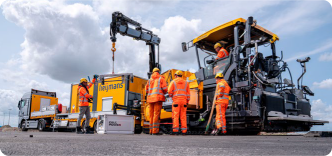
Heijmans has also invested heavily in emission-free equipment in recent years, from pile driving rigs to asphalt kits, meaning we can now carry out construction work completely emission-free. However, it is important that we encourage clients to specify on a consistent basis the use of emission-free equipment during the tender phase and therefore reduce CO2e emissions further. One such example is TenneT, which has included the use of emission-free equipment as an important criterion in the updating and expansion of the Maasbracht high-voltage substation. We urge clients to follow this example and to make emission-free equipment part of their tenders as standard.
To accelerate our ambition, we developed in 2025 the first mobile charging bay for electric construction equipment in partnership with the company Bredenoord. The charging bay can be deployed in a range of locations and enables excavators, loaders and trucks to be charged efficiently using green electricity. The mobile charging bay was first commissioned at Schiphol, where it was used during works on the Buitenveldertbaan runway.
Renewable energy and fuels
Heijmans makes its electricity and gas greener through Guarantees of Origin and invests in direct sustainable generation, such as solar panels in offices and on building sites. Furthermore, we are also researching the use of hydrogen. We use HVO fuel instead of diesel where the electrification of heavy equipment or transportation vehicles is not possible. The next step is to implement this transition together with subcontractors as well.
Klimaatexamen
In May 2025, around fifty Heijmans employees took part in the Klimaatexamen (Climate assessment), an initiative that allows participants to put their knowledge of climate change to the test. They answered twenty-eight questions on the causes, consequences and potential solutions, with an average score of 7.5. Heijmans was the first company to sign up to the initiative.
Heijmans will register for the Klimaatexamen again in 2026 to raise awareness of climate change among its staff even further.
Major maintenance
Case study: Buitenveldertbaan (Schiphol)
In the summer of 2025, Heijmans, together with the Royal Schiphol Group and various chain partners, carried out major maintenance work on the Buitenveldertbaan runway. Over the space of twenty weeks, 3.5 kilometres of asphalt were replaced, 1,800 luminaires were fitted with LED lighting, around 400 kilometres of cables were laid and five kilometres of drainage gutters were replaced. All of this work was carried out while the surrounding taxiways remained in operation.
By carrying out these works in as sustainable manner as possible, we achieved CO2e savings of 6,580 tonnes. In total, close to 100,000 tonnes of asphalt were laid, with 90% of the asphalt released during the works earmarked for reuse in projects at Schiphol. More than 60% of the asphalt released was reused as part of the Buitenveldertbaan project. Other materials, such as the concrete used in the foundations for the drainage gutters and the repaired concrete sheets at the end of the Buitenveldertbaan, were also circular. The project was also executed emission-free to a large extent. Two permanent charging bays and one mobile charging bay ensured the construction equipment could be charged using green electricity. This approach demonstrates how Heijmans makes a tangible contribution to CO₂e reduction in infrastructure through sustainable techniques, efficient working methods, circular material flows and emission-free execution.
Water
Water is the basis of all life on earth. Due to climate change, we are facing more and more floods and periods of drought, and these extreme situations are only increasing. In the Netherlands, we can and must use rainwater, groundwater and surface water more intelligently. Heijmans has an impact on the water system through our operations in public areas and at our own offices and building sites, as we come into contact with water in all our activities. At the same time, we have the knowledge and expertise to improve water quality and water quantity.
Our water vision is built around four themes: water quality, water balance, water use and water safety.
Water quality
We want to improve the quality of our water and prevent pollution. In 2025, we carried out an impact assessment, in collaboration with TAUW, a leading European environmental consultancy firm, as part of the Water Framework Directive (WFD). This allowed us to map out the effects of our activities on water quality and which actions can be taken to improve them.
We also develop innovative solutions that we can implement directly in practice. One such example was the installation of a plastic trap in the canal from Ghent to Terneuzen to remove plastic from the surface water. We also developed in 2025 a compact, mobile water treatment system to clean groundwater and surface water on site, which can be deployed quickly to a wide range of projects.
Water balance
We work according to the principle of 'water and soil management' to achieve a healthy water balance. This means that we take water safety, flooding and subsidence into account in our designs. We use tools such as the Ecology, Soil and Water scan (EBW scan) and the Sustainable Design Principles (SDP) to find the right balance between ecology, soil and water.
The EBW scan maps out the framework conditions of the natural system, and we analyse opportunities and risks and recommend specific measures. These are then included in discussions with the client or serve as input for work plans and designs. The EBW scan helps to prevent drought, flooding and subsidence. The scan has since been applied in eight area developments and four infrastructure projects.
The Sustainable Design Principles (SDP) that were refined in 2024 were applied to our designs in 2025. For water, this means creating designs that are water-resistant, with minimal paved areas, a well-functioning drainage system and, as a preference, surface water collection systems such as bioswales. We work with heights safe from (ground)water and seek to prevent water pollution
This aligns with the broader ambition Heijmans formulated in 2025 regarding the water balance. We take area-specific measures to address flooding, drought and water stress in projects where water-related challenges arise. In doing so, we aim to positively influence the water balance. In 2026, we will establish a concrete water balance for a number of projects and determine which additional measures are required.
Water use
Of course, we also keep track of our own water use with the aim of reducing our 'water footprint'. We distinguish between the following focus areas: drinking water use in our own business operations, drinking water use in buildings and water use in the production of raw materials.
Heijmans has set itself the goal of using 30% less drinking water in its own office and project sites by 2030 compared to 2019. We aim to achieve this reduction by limiting water use, using sustainable water sources such as rainwater and surface water, and making efficient use of non-renewable water sources.
To reduce drinking water consumption and better manage peak loads during heavy rainfall, we launched a pilot in 2025 for rainwater storage in five new-build projects in Rotterdam, Leerdam, Nijkerk, Middelburg and Lemmer. The homes will be equipped with a system that collects and stores rainwater for it to be reused for flushing toilets, running washing machines and watering gardens. The first two homes in Drachten were delivered with this system in 2025. The projects in Leerdam and Nijkerk are on sale and will be realised in 2026.
This approach allows us to research how we can achieve structural savings in drinking water in the built environment. At Eindhoven Airport, Heijmans installed a water buffer in 2025 to collect 320,000 litres of rainwater as part of the terminal expansion project. This water is reused for flushing toilets and more, saving around 1.5 million litres of drinking water a year and reducing peak loads on the sewerage system. In Rotterdam-Zuid, an underground water buffer was constructed as part of the Hart van Zuid project. Rainwater is collected at Zuidplein and the Ahoy car park, treated and stored in an underground basin, after which approximately twenty million litres of water can be used a year for flushing toilets, cleaning, a water plaza and for improving the water quality in Zuiderpark. A water buffer is also being installed at the provincial government building in Zwolle. During the reconstruction of the De Nieuwe Meer junction in Amsterdam, we saved more than 120,000 litres of drinking water a week by using water from the Schinkel river for producing grout and concrete instead of tap water.
Raising awareness
We launched a range of initiatives in 2025 to raise awareness around water use and climate adaptation. In the podcast Kan het samen?, CEO Ton Hillen talked to Delta Programme Commissioner Co Verdaas about how we can make the Netherlands resistant to extreme weather conditions so we are able to withstand large amounts of water, but also make sure we have enough during dry periods. During the National Climate Week in Almelo, we also opened the WaterWeetjesWagen, a mobile car that allows young and old to see how small actions, such as disconnecting a drainpipe, a green roof or increased planting, help to combat flooding, drought and heat stress. This activity allowed us to bring knowledge and perspectives on actions that can be taken on climate adaptation straight to the district.
Water safety
Climate change has extra significance for the Netherlands, which largely lies below sea level. Due to rising sea and river levels, caused by snow melting in the mountains of nearby countries, heavy rainfall and more, water comes at the country both from the sea and from the land. These events are forcing us to take timely actions to prevent flooding.
Heijmans is working on reinforcing the national dyke system and building new housing developments that can withstand high water levels. In doing so, we are actively contributing to keeping our water system safe and making it safer. In December 2025, the Gorinchem-Waardenburg dyke reinforcement project was declared flood-proof and close to completion. The Lauwersmeersdijk-Vierhuizergat dyke reinforcement project is also at an advanced stage. This project includes a tidal sluice, among other measures, which can partially reduce the tide in the Marnewaard behind the dyke. Construction of the Sterke Lekdijk project also began in 2025, while a new project was added to our portfolio with the award of the project to reinforce the Thorn-Wessem dyke.
Biodiversity
Biodiversity is an integral part of our sustainability strategy. We recognise that healthy nature and biodiversity are a prerequisite for both our organisation and society as a whole. Alongside the climate and water, biodiversity plays a crucial role in improving our living environment, so we leave it in a better state than we found it. Due to the nature of our activities, we are always interacting with biodiversity. We have an impact on biodiversity in our operations and value chain, while at the same time being dependent on the ecosystem services provided by nature. Our vision is therefore twofold. On the one hand, we want to improve biodiversity by reducing our impact and achieving a nature-positive impact wherever possible. At the same time, we apply ‘Nature as a solution’ by responsibly using the ecosystem services provided by nature, strengthening them where possible and actively applying them to the challenges we encounter in our work.
Improving biodiversity
We improve biodiversity by focusing on space for nature, species richness, environmental conditions and nature as a resource. We come into contact with existing nature in and around outdoor spaces in our projects and activities, or can create additional space for nature. We contribute to protecting and strengthening nature, for example by creating ecological verges and wildlife crossings in infrastructure projects that connect natural areas. In residential environments, we can reduce the amount of paving and create additional space for nature with green facades and roofs.
Increasing biodiversity requires variety in planting and living environments. Nature-inclusive measures, such as planting native flora, installing insect hotels and developing nature-friendly banks and flowery verges, create a range of biotopes. This allows us to increase diversity in an area and strengthen local ecosystems. A tangible example is the construction of a secondary ditch in the Maas near Herwijnen, where we combine a dyke reinforcement with enhancing biodiversity.
In addition, we can protect and enhance biodiversity by reducing the use of harmful substances, reducing emissions such as nitrogen and CO2, and preventing the spread of pollution such as microplastics. We can also use smart techniques and working methods to contribute to healthy soil. As an example, we are working on a soil health index for the urban environment as part of the UrbiSoil research project together with partners such as Wageningen University to ensure fundamental knowledge can be applied to our projects.
Finally, we limit the impact of extracting resources by focusing on nature-inclusive, regenerative and sustainable use of natural resources. We have been using renewable raw materials such as wood and hemp fibre as well as reducing the use of primary raw materials such as gravel and metal for years. Our commitment to the National Approach to Biobased Building (NABB) for the civil engineering (GWW) sector reinforces the path we have chosen.
Nature-based solutions
Robust nature gives us a lot back in the form of ecosystem services. The application of NL Greenlabel's NL Gebiedslabel in our area developments creates additional space for nature in public spaces. A stronger nature makes a direct contribution to improved climate resilience and to residents' physical and mental well-being.
Furthermore, nature offers countless examples of efficient and sustainable solutions. By studying and applying natural principles, we can make our operations even more sustainable. One such inspiring example is the application of self-curing concrete at the railway tunnel in Gilze-Rijen. A combination of bacterial spores and nutrients forms a 'healing agent', as it were. The bacteria become active as soon as they come into contact with moisture and oxygen through tearing. The tears are then filled by the bacteria with a sealing layer of limestone. This addition reduces the amount of reinforcement steel required and increases the lifecycle of the structure.
Part of our work processes
We are working on methods to make nature restoration and enhancement measurable in order to ensure biodiversity becomes a structural part of our work processes. The Natuurladder, which Heijmans co-developed and transferred to Stichting Deltaplan Biodiversiteitsherstel, is now widely available in the construction sector, and allows project teams to determine how their decisions contribute to biodiversity and the quality of nature in a standardised manner.
To support Heijmans employees in strengthening biodiversity within projects, Heijmans has introduced a Biodiversity Measures App (new window). a practical tool that shows which actions you can take to improve biodiversity or use nature-based solutions for each phase of a project. The actions range from simple interventions on a building site, such as the installation of nesting boxes, to more integrated solutions in the design, such as the installation of a green facade. The app will be developed further in the coming years.
BioBuddy
Heijmans is developing BioBuddy, an innovative measuring box that uses artificial intelligence (AI) to measure and analyse biodiversity in an area. BioBuddy continuously collects image and sound material from flora and fauna, such as insects, birds and mammals, and sends the data to a central database for further analysis.
In 2025, the BioBuddy was deployed at various project locations to monitor and quantify biodiversity. As an example, the system will be used in the green transformation of the University of Amsterdam on Roeterseiland, where the campus will be developed into a future-proof, nature-inclusive environment in the years ahead. BioBuddy is also being used at De Kemmer in Oirschot to chart the presence of insects, birds and small mammals and monitor changes in biodiversity over time. BioBuddy also includes BirdBuddy, which uses acoustic monitoring to recognise and analyse bird sounds. We can gain valuable insights into biodiversity by mapping out the number and diversity of bird species in an area. BirdBuddy has been installed at the Military Museum in Soest as part of the area development.
Sustainable area developments
Our current goal is for all area developments in which Heijmans is involved to achieve an NL Greenlabel Gebiedslabel with an A rating by 2030. This goal means we are consciously raising the bar for sustainable area developments. The NL Greenlabel method, which was updated in 2023, assesses projects based on aspects such as energy, biodiversity, mobility and water, expressed in ratings from A (excellent) to G (inadequate). Various Heijmans projects have since been awarded an A or B rating. In addition to Leusden, Ermelo and Uden, Hoogkamer Voorhout also received a final Gebiedslabel with a B rating in 2025. At the time of writing, the design phase has been completed for eight area developments, with pre-screening completed for ten area developments. For infrastructure projects, we work with the Natuurladder and aim to achieve Step 5.
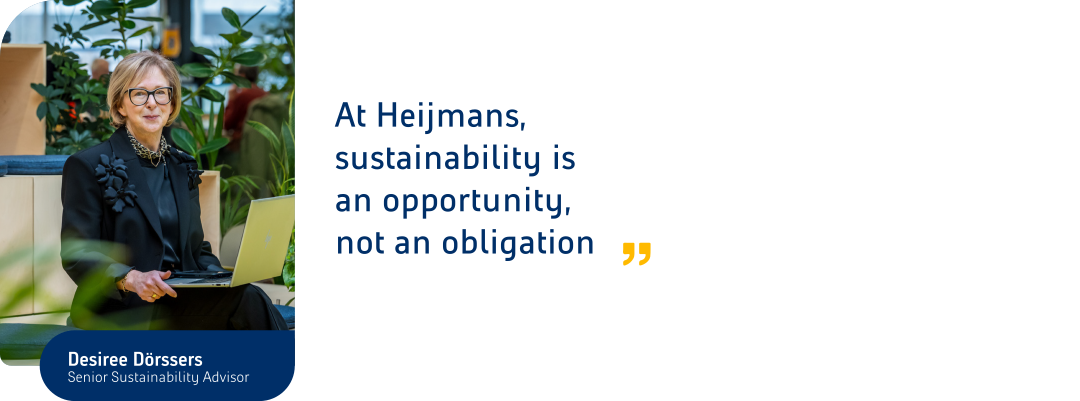
"In 2025, Heijmans won the CSRD award for its 2024 sustainability statement. This recognition for transparency and sustainability is a huge boost for the whole team and confirms that we are on the right track. Compliance with legislation such as the CSRD is necessary, but at Heijmans it doesn't feel like an obligation. Instead, we see it as an opportunity to further strengthen our role in society. We are genuinely motivated to do better every day, while keeping a long-term perspective, the human dimension and a healthier living environment in mind.
Good reporting also plays an important role here, as it provides insight, focus and direction. The CSRD has helped us to draw up more precise goals, strengthen the collaboration between departments and get a clearer picture of the risks. We're not there yet, however. Data quality and further integration into our processes remain focal points. That's precisely why I am proud to work at Heijmans: because sustainability is not just an abstract concept here, but rather something that we make more specific and tangible together."