Well-being is central to everything we do at Heijmans. Our work revolves around creating safe, healthy and attractive environments in which people feel comfortable. The social environment in which we operate is challenging. Developments such as inequality of opportunity, transport poverty and heat stress have a direct impact on people's well-being. Our responsibility does not end at project completion.
As we design, build and maintain future-proof homes, buildings and areas. It is precisely during the utilisation phase that our interventions have a lasting impact on consumers and end users; this is therefore where we focus our attention. This topic relates exclusively to the utilisation phase; temporary disruption during construction falls outside its scope. We use our projects to respond to societal challenges and strive to promote people's well-being.
Policy
In 2025, we developed a well-being policy that focuses on formulating clear principles and frameworks. As set out in our strategy, we focus on creating environments that are safe, healthy and attractive, and that is where we can have a direct impact. For each impact theme, we have developed three impact factors that fall within our sphere of influence. In the Well-being topic, we build on growing knowledge and remain curious with regard to new insights. As such, we work according to three clear principles that guide our actions.
-
We base our reasoning on consumer and end users and local assignments:
The environment in which Heijmans is responsible for the construction of buildings, infrastructure solutions and other public facilities presents a range of opportunities and challenges. We are constantly investigating which solutions deliver the greatest added value for consumers and end users. We are aware that there may be conflicting interests; we opt for solutions that deliver a positive impact for the largest group of consumers and end users. It is therefore important to assess whether the problem we are investigating actually corresponds to what people are experiencing in practice. -
We learn by doing:
Heijmans opts for a learning by doing approach. We see that little is known and proven when it comes to interventions for well-being in the living environment. Monitoring and measuring the effects of interventions takes time, as social change takes time. -
We work based on evidence-informed decision-making:
Evidence-informed working differs from an evidence-based approach by attaching value to expert knowledge and practical experience in addition to the need for robust, scientifically supported evidence.
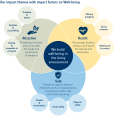
These principles form the basis of our way of working, both in practice in projects as well as for monitoring the results and, where possible, the outcomes and effects. Our awareness of societal challenges and these three principles allow us to ensure that the interests of our key stakeholders, the consumers and end users, are always taken into account. By working methodically and broadening our knowledge, we gain an increasing insight into how effective Heijmans' interventions are in practice. By starting small, we learn about an appropriate way of working where we base our reasoning on the consumers and end users and the local assignment. In 2025, we applied an impact scan to several projects. An impact scan is conducted based on public data, local policy documents and reports, and site visits in which local stakeholders are consulted. In 2025, Heijmans does not yet have a complete picture of the views of consumers and/or end users who may be particularly vulnerable or belong to marginalised groups.
In 2026, we will develop the policy into a methodical approach that is both feasible and can be tested in collaboration with knowledge partners.
Targets and actions
Heijmans has not yet drawn up any specific actions and targets with regard to the material impact identified, as we first want to test the method and tools drawn up. We still have an insufficient understanding of the resources intended to manage such an impact.
In 2026, we will start our area developments, where there is a clear alignment with the challenges we are facing. We intend to make the Well-being approach an integral part of our way of working in this area. Doing so allows us to gain experience in practice and learn how we can enrich and take responsibility for our way of working. At the same time, we are investigating how the method can be applied more broadly within Heijmans to other fields of work, in order to ensure that we as Heijmans can increasingly guarantee a 'quality standard'.