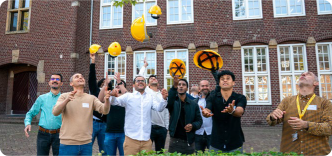
We need a new, effective approach to tackle the complex challenges of our time. Heijmans is happy to take the lead on this front. We create strong networks and involve surprising new parties. We stand shoulder to shoulder with our clients in creating groundbreaking solutions. Together, we identify the dilemmas and put our heads together to determine how we can tackle them in an integrated manner. This is only possible if we enter into long-term relationships, with our clients of course, but also with suppliers and other partners. We join forces and learn from each other so we can take significant steps forwards together.

Alongside our clients
We don't want to wait for clients to ask us a question. By delving deeper into the tasks our clients face today and tomorrow, we can link our knowledge and experience to our clients' to start from a common goal and leverage each other's strengths.
The strength of a strong client relationship lies in mutual trust and long-term cooperation. This is clear from the continued growth of the recurring business revenue share in our portfolio, including long-term framework contracts and one-to-one orders. What's more, it is also clear evidence that we not only know our clients, but also truly understand them.
In 2025, for example, we worked closely with the Dutch Central Government Real Estate Agency on the temporary home for the Ministry of General Affairs. The project at Bezuidenhoutseweg in The Hague was highly complex, involving a national monument, a short lead time and drastic structural modifications while the building remained partially in use.
Success was only possible thanks to intense cooperation and mutual trust between the Dutch Central Government Real Estate Agency as the client, Heijmans as the main contractor, the users and the consultants, suppliers and subcontractors involved. This type of cooperation is also reflected in our relationship with the Ministry of Public Works and Water Management, a long-term relationship in which we actively contribute to the huge renovation task relating to Dutch infrastructure. Long-term asset management contracts enable us to contribute to the future-proof management, maintenance and upgrading of vital networks.
The same collaborative strength is reflected in our relationship with TenneT, where, with the opening of the Krachtveld facility at the end of 2025, we are working together to accelerate the expansion of the electricity grid. By enabling the prefabrication of high-voltage installations in a conditioned environment, we reduce the lead time compared to the traditional construction method on the construction site itself.
Heijmans is one of the construction companies participating in the new Commandopost Vastgoed (CPV): a partnership between the Ministry of Defence, the Dutch Central Government Real Estate Agency and market players that combines upgrading the Dutch military infrastructure and strength with the knowledge, capacity and innovative power of the construction sector. The establishment of the CPV stems from the huge task that the Ministry of Defence is facing: to accelerate the implementation of modern, sustainable and affordable facilities, from barracks and accommodation buildings to training facilities and airbases.
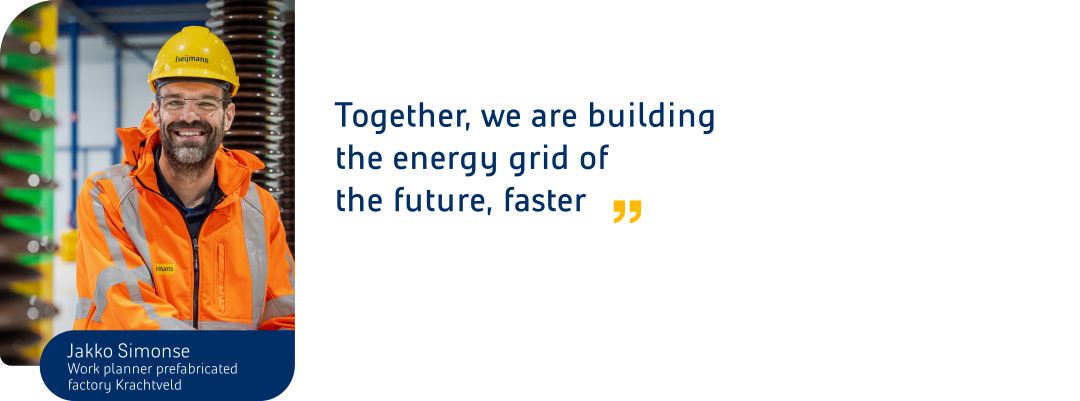
Last year saw the opening of the Krachtveld prefabrication factory in Ede. In 2025, the focus was firmly on getting it up and running and its design. Jakko Simonse started as a work planner at Heijmans during that period. "The open culture caught my attention straight away. As part of a small team, we are building modular high-voltage installations together with TenneT. The collaboration is intense and enjoyable. Team members on the client's side are regularly present on site at the factory to coordinate and seek out improvements together. This truly makes the accelerated production of the high-voltage installations a joint task."
The first modules are expected to be delivered in early 2026. "Heijmans is a large organisation, but it is one with short lines. This ensures efficiency and makes collaboration rather straightforward. Heijmans has traditionally been strong in project-based work; the prefabrication plant is now all about production. That requires a different way of thinking and of doing things. It's this change that makes it a fantastic challenge."
Types of contract
Our goal is to use our broad expertise – from infrastructure and energy to property development, construction and management – to make the greatest possible contribution to a sustainable future for the Netherlands. That is why we prefer to choose the type of contract that involves us being selected on the basis of our added value, so we can use our own expertise and that of our client to achieve a common goal. We value transparent, relationship-focused forms of collaboration, such as in construction teams or with two-phase contracts and framework agreements. We also work in alliances on large-scale, complex and long-term projects. One such example is the Graaf Reinald Alliantie, in which the Gorinchem-Waardenburg dyke reinforcement is being implemented in partnership with Waterschap Rivierenland.
Area developments are a long-term process that require long-term commitment and trust between public and private partners. In early 2025, Heijmans became the exclusive partner for the first phase of De Kemmer's area development in Oirschot. Together with the municipality, we are working on a shared vision for a new residential landscape of around four hundred homes, with a focus on nature-inclusive and biobased construction and community building.
Improving customer relationships
It goes without saying that we are constantly looking for ways to further improve our customer relationships. In the Working segment, we do this through our Customer Service Excellence programme. Structural discussions with clients have shown to improve customer satisfaction, which translates into an increase in the average satisfaction rate to 7.8, having previously been stable at 7.5 for years.
To take the next structural step here, we started mapping out the entire customer journey in 2025 in all phases of the relationship – from exploration and tenders to the start of provision of service, optimisation and the delivery process. We translate the insights from this analysis into a specific improvement and innovation agenda, which we use to continue to develop our organisation in a targeted manner. We are now working towards ensuring a stable customer satisfaction rate of eight and above in 2026 and 2027 and, in the long term, even achieving nine and above on the most valuable interactions for customers.
Moreover, Working also has a client advisory board to which we regularly invite clients to discuss strategic themes, market developments and cooperation. The client advisory board acts as a structural platform for testing strategic initiatives and gaining better insight into what is happening on the market. The board contributes to strengthening customer relationships and exploring new forms of collaboration. In 2025, three meetings took place on the themes of connectivity, innovation and data governance.
Consumers as clients
We are also taking steps to improve the customer experience when it comes to individual buyers. In 2025, we launched heijmansnieuwbouw.nl, a platform that clearly displays our entire range of new-build homes.
The platform also includes the Nieuwbouwhulp, a resource that allows us to support consumers at every stage of the journey – from initial exploratory steps to delivery – with practical information and advice. We also offer targeted guidance for more sustainable and pleasant living through the Nieuwbouwhulp to help (future) residents with specific tips, such as greening the garden, maintaining solar panels and a healthy indoor climate.
Collaborating in the value chain
We believe in the strength of long-term collaboration, which is why we work closely with our partners and suppliers. By sharing knowledge and joining forces, we increase our contribution to a healthy living environment. This requires targeted guidance on content and collaboration, so we can take joint responsibility and manage risks more effectively. The result: predictable, successful projects with benefits such as greater efficiency, cost control and higher quality.
Co-makers
In the Living segment, we work with a number of regular partners, or so-called co-makers, for the production of Heijmans Huismerk homes. In 2025, for our low-rise Huismerk homes, we further deepened this approach by steering within the Service Level Agreements (SLAs) also on softer, jointly defined performance indicators, such as safety, sustainability, digitalisation and delivery reliability. This way of working is directly in line with our strategic ambitions. Long-term cooperation offers our partners security and forms a solid basis for continuing to innovate and becoming more sustainable.
Innovation through collaboration
The power of collaboration is also clearly evident in our approach to area development. In Rotterdam, we are working on the redevelopment of the former Hunter Douglas site in collaboration with various market participants. The project represents a new part of the city where living, working and manufacturing come together, and shows how joint investments can lead to innovative, feasible concepts.
We are also working closely with the client on future-proof, strong neighbourhoods in other complex area developments. In early 2025, we signed an agreement with De Bazaar in Beverwijk for the first phase of area development. Around a thousand sustainable homes will be built across five phases, with the project contributing to the housing demand in the region and the transformation into an integrated living and working environment.
Other attractive examples are the area developments in Dreven, Gaarden and Zichten in the Zuidwest district of The Hague. This large-scale urban renewal project won the SKG Award for Sustainable Area Development in 2025, as recognition for close cooperation between public and private parties and paying attention to social, ecological and economic value creation.
In IJsselstein, too, we are successfully working with the municipality, the province and the grid operator Stedin on the Roba project to be able to build new homes despite grid congestion in the region. The project involves transforming a metal factory into a new residential area and, by developing a collective energy system, we combine local generation, buffering and smart energy control to minimise the impact on the electricity grid.
Industry-wide impact
Safety is one subject where joint action in the value chain makes the difference. We lead the way and actively work with suppliers, subcontractors, industry associations and fellow construction firms to reduce safety risks on a structural level wherever possible.
In 2025, we introduced an AI detection assistant on our construction equipment, where the AI technology automatically detects people and objects around the equipment. Eight machines from our fleet and a truck were fitted with this technology, as well as an AI emergency braking assistant. These systems help to reduce one of the greatest risks in construction: collisions between people and equipment. Introducing these systems sent a clear signal to the industry – these safety features should be fitted to new construction equipment as standard, and not something that is added at a later date. By creating demand together with our partners, we accelerate the availability of safer machinery across the industry as a whole.
We believe that joining forces is essential to achieve a structural impact in the area of nature, too. That is why Heijmans Working signed the Net Natural Profit Manifesto in 2025 together with other market players and nature organisations. This manifesto allows interested parties to call for a legal standard for net natural gains in construction and development projects, inspired by Biodiversity Net Gain in the United Kingdom. This means that nature restoration becomes a permanent, predictable part in projects, and each project demonstrably yields more or better nature.
Innovative ecosystem
We are very aware that we will not be able to realise our strategic goals alone. That is why we are building an innovative ecosystem that involves research institutes, start-ups and specialised suppliers. These partners will help us find solutions to a wide range of issues – from digitalisation to circular construction – and achieve major breakthroughs for a variety of complex social issues.
We work with institutions such as Wageningen University & Research (WUR), Deltares, Naturalis and Vogelbescherming Nederland (Dutch Society for the Protection of Birds). These knowledge partners provide insights and applications in the areas of nature-based solutions, biodiversity monitoring and healthy soils and water systems. In 2025, we also strengthened our partnerships with Stichting Deltaplan Biodiversiteitsherstel, a foundation for restoring biodiversity, and WaterBank. Furthermore, the Greenlabel Institute was officially launched in 2025, which houses the knowledge, methodology and scientific council of NL Greenlabel. Heijmans is affiliated to this foundation as a partner.
Our collaboration with Staatsbosbeheer continued to take shape and was scaled up further in 2025. We have resolved to plant a forest of 16,000 trees every year until at least 2030. The newly created forests absorb CO2 and contribute to biodiversity. In addition, the collaboration was expanded in 2025 with Door de Bomen, a new concept for area development in outdoor spaces that combines the large-scale development of nature with substantial housing constructions. Heijmans was also the main sponsor of the National Tree Day in 2025, celebrating the start of the planting season in November under the theme 'Lekker leven met bomen' (Happy living with trees). All across the Netherlands, children, municipalities, partners and organisations came together to plant new trees.
All these partnerships contribute to our innovative potential and therefore to the realisation of a healthier, more sustainable living environment.
During Dutch Design Week 2025, we launched co-labs, where we seek to collaborate with designers, researchers and start-ups to work on themes such as well-being, water and biobased construction materials. By connecting creative thinkers and domain and implementation knowledge, we aim to unlock new perspectives for complex spatial tasks, which we then translate into our projects.
We are also taking steps in the area of smart technology together with specialist partners. One such example includes Avular, Europe's first self-propelled electric asphalt roller. By combining expertise from other domains with our own knowledge of infrastructure, we achieved a breakthrough that both promotes safety and provides a solution to the future shortage of skilled workers.
Kan het samen?
To strengthen collaboration, we actively seek to connect with our environment. We also aim to connect through our podcast series Kan het samen?, in which CEO Ton Hillen talks to prominent people from a range of organisations about societal dilemmas such as the housing shortage, the energy transition and biodiversity.
The approach is clear: how do we deal with seemingly contradictory tasks, such as construction and preserving nature? The following podcasts were released in 2025:
Partnership, Koning Willem I College
Case study: Training for newcomers
Heijmans and the Koning Willem I College have joined forces to develop, at Heijmans' initiative, the 'Toekomstvaardig' construction training course, specifically aimed at newcomers. The first group of thirteen participants officially started in 2025. They already work at Heijmans and combine practical experience on building sites with specialist knowledge, language training, cultural orientation and coaching.
Heijmans offers newcomers an opportunity for work and education through social involvement and the valuable contribution they make to the organisation. Many newcomers have a technical education and work experience that are a great fit with Heijmans' projects. The partnership with Koning Willem I College gives them the opportunity to further develop their skills through targeted training. The next development is to broaden the training by making it available to other companies within and outside the sector, which started in 2025. Over twenty-five organisations attended a company meeting to explore the options the programme offers. In addition, the impact can be increased further by expanding the training offer to other regions. Several vocational secondary schools have now shown an interest in offering the training course, with Amersfoort vocational secondary school intending to start in September 2026. We are therefore launching an important movement to make the 'Toekomstvaardig' course more widely accessible and strengthen the inflow of newcomers into the sector.