The continuing scarcity in the labour market is impeding progress on the complex and growing challenges facing the Netherlands. With fewer people able to carry out the work, we need a fundamental change in working methods and production methods: working smarter, not harder. We use advanced digital technology and modular and industrial construction techniques to develop safer, faster and more sustainable solutions, which are offered in a unique bundle.

Working twice as smart
Our goal is to double the contribution per employee by 2030 compared to 2020. We distinguish between two coherent, main streams to support our development within the Producibility pillar: digitalisation and production technology. We harmonise our ways of working and use digital and technological applications. We pool our knowledge and expertise in smart systems to further digitalise, automate and industrialise processes. We combine modular building blocks into tailor-made solutions that meet specific customer requirements in order to reduce lead times, increase safety, production and quality, reduce failure costs and exploit new business opportunities, without sacrificing diversity. Furthermore, we contribute to reducing the waste of scarce materials.
Digitalisation
Digitalisation enables us to organise our work more effectively and efficiently. By pooling data, we can create new insights and develop smart solutions. Adding AI to digital processes enables us to get more done with fewer resources, making digitalisation an important accelerator for innovation and growth.
Developing areas digitally
Our goal is to realise our scenarios for area and building developments largely through generative and parametric methods by 2027. We use data models to map out the context of our projects, allowing us to gain a better, faster understanding of promising solutions. While formulating plans can currently take months or even years, our ambition is to be able to go from an idea to a detailed plan within thirty days by 2030.
We take a step-by-step approach towards a fully digitalised development process, from area analysis to spatial design. To this end, we took specific steps in 2025, such as introducing the Geographic Information System (GIS) across Living to give us up-to-date area data that helps us to assess opportunities, risks and social factors such as well-being and sustainability at an early stage. This lowers lead times, reduces failure costs and improves the quality of our plans.
The application of GIS is still in its infancy. By integrating GIS into our standard way of working, we can make future solutions richer and more complete, and thereby better align them with the social issues faced by our stakeholders and users.
Furthermore, in 2025 Heijmans, together with clients, carried out various pilot projects with parametric designs in order to arrive at designs of higher quality and with greater support using a faster, smarter process. Parametric designs allow us to calculate thousands of scenarios on financial, sustainable and social parameters at great speed, leading to better choices, fewer iterations and shorter lead times. This methodology enables us to make the impact of design choices visible and move towards data-driven decision-making. The next step is to apply parametric design more widely in our area and building projects, so that we as an organisation and value chain can learn more when working with this digital methodology.
Digital construction
4D model
At Heijmans, we are increasingly focusing on digital construction. The 4D model plays a central role here. As an example, we simulate the execution of projects, including complex lifts, phasing and the deployment of equipment, before we even get to work on a building site so we can identify risks at an early stage, plan work more efficiently and increase safety on the building site.
The 4D model offers colleagues a single, central location where all project data comes together, allowing us to lay a structured foundation for the use of AI applications. We use 360-degree camera techniques to add real-time information from building sites to the digital model. Doing so allows teams to gain quick insights into planning, available space and the coherence between activities. The 4D model is therefore becoming the foundation for a full digital simulation of our construction projects.
Automated repetitive tasks (ART)
In 2025, we further developed and implemented the automation of repetitive tasks (ART) within the design process, with a focus on electrical and mechanical installations (E&M). Task automations for installing recesses, generating wall projections, applying layouts and entering data into models have been standardised and made more efficient. This means the number of task automations has increased, as has the number of projects and modellers using them.
One example is the wall layout generator, applied in eight projects, including Physics at TU Delft. This alone resulted in a saving of around one hundred engineering hours for electrical wall projections. In total, we saved more than 2,500 engineering hours in 2025 with task automations in non-residential projects.
Digital customer journey
In 2025, we made progress in digitalising the customer journey within Working and Living, with the aim of providing clients with faster, better and more consistent support. A new customer platform has been developed within Working (Services) to digitise and simplify processes in order to give customers and customer teams better insight into the status of maintenance contracts. A new, self-learning customer service tool has been launched within Living. This application helps to determine the urgency of customer requests and supports employees in handling reports faster and with greater care.
Living has also developed a new digital method for recording and reporting customer satisfaction, which is now measured throughout the entire B2C customer journey. This provides detailed insights into what is going well and where optimisations can be made.
Data-driven asset management (Connecting)
We manage and maintain infrastructural works for public and private clients right across the country, including the Ministry of Public Works and Water Management, Schiphol Airport, provincial and municipal authorities and port authorities. We monitor a growing number of digital systems such as traffic lights, roadside stations, charging infrastructure and public lighting. We also use sensors to continuously monitor roads, viaducts, locks, dykes, bridges and other fixed structures. This allows us to identify any deterioration in the condition of objects such as roads and civil engineering structures at an early stage and to plan maintenance in a targeted manner. All data from these systems is gathered in the Connect platform developed by Heijmans. This platform will be further expanded in 2025, including functionalities for dynamic roadside systems (systems along the Dutch highways that inform and control traffic depending on road conditions), so that maintenance can be planned and carried out more efficiently.
We are also enriching our asset management services with new data sources and smart applications. At Schiphol, we are developing an integrated maintenance dashboard that combines sensor data with third-party systems, enabling more accurate maintenance scheduling and faster detection of anomalies. For the maintenance of locks and bridges, we use an updated Object Data Service, which uses modern communication technologies to provide reliable, up-to-date information on the condition of these assets.
In the area of infrastructure quality, we use a proprietary digital application that predicts the degradation of asphalt. We calculate coherent packages of measures (scenarios) to allow us to assess the effect of different maintenance decisions on costs, sustainability and efficiency in advance. As such, our specialists' expert knowledge is used in predictive models that support well-founded maintenance planning for the road network.
All these initiatives contribute to a noticeable acceleration of our digital transformation and to a future where management and maintenance are increasingly data-driven, more predictable and more efficient.
Working on a digital future
Our aim is to be able to provide predictive information to support half of our service and asset management contracts by 2027. To achieve this, we continue to invest in sensor technology, data links and AI applications. Data processing is becoming increasingly sophisticated: in addition to performing trend analyses and monitoring threshold values, we use AI to develop automated insights and predictions of system behaviour. Together with clients, we explore what information they need to ensure management and maintenance is smarter, faster and more efficient.
In order to apply knowledge and working methods in a repetitive, uniform manner in our processes, we continue to focus on standard procedures and IT solutions such as the Connect platform. In doing so, we are gradually building towards operational excellence: efficient and profitable management and maintenance, with maximum value for our clients.
In addition to these developments, we are also investing in our internal digital foundation. This starts with well-organised and unambiguous data, which is essential for deploying AI securely and at scale. That is why we are working on an organisation-wide approach to data management, in which we develop standards, practices and data skills step by step to create a solid foundation for data-driven working as well as the conditions for further scaling up AI applications in the coming years.
At the same time, work on the roll-out of AI applications and AI agents within Heijmans is ongoing, aimed at increasing the efficiency of personnel and teams. One such example is the introduction of the AI Writing Suite within Connect. This application automatically generates initial drafts of standardised documents based on project-specific data and internal best practices, resulting in significant time savings. In 2025, we launched a pilot project for project management plans to refine the functionality in practice. The pilot project is being carried out in co-creation with users, which means that the application fits neatly into the daily work processes. Upon successful completion, the Writing Suite will be expanded in 2026 to include other document types, such as work plans and progress reports.
Production technology
How we produce and build will change dramatically in the coming years. At Heijmans, we are embracing the possibilities of digital technology and investigating how we can run production processes more safely, faster, better and more simply. We aim to work twice as smart instead of twice as hard, There are significant opportunities in the areas of standardisation and modular and industrial production.
Standardisation of processes and working methods
Standardisation is an essential step towards more efficient construction. By ensuring processes and (partial) designs are repeatable, components for buildings, roads and bridges can be used more frequently to prevent each project from being completely redesigned. Standardisation delivers significant benefits such as increased safety, greater efficiency, shorter lead times, lower failure costs and better quality. At the same time, our standards continue to offer sufficient flexibility for customisation, depending on specific situations and user needs.
Conceptual development and construction
We work with our home products – a standardised range of both homes and apartments – where possible. These homes are made of concrete and wood, where we increasingly use prefabricated elements and, in some cases, even complete houses to guarantee higher safety and quality, lower failure costs, a faster process and greater affordability. This approach allows us to make a tangible contribution to accelerating the housing construction project. We use modular components to create unique customer solutions at the same time.
Our aim is to deliver 70% of our homes using this method by 2030. To achieve this goal, we have developed a variety of modules. During the design phase, we work closely with our partners to meet the needs of our clients as effectively as possible.
We have gained a lot of experience with this client-driven and technically sophisticated approach over the past twenty years, including with Heijmans Huismerk houses, apartments and urban apartments, our Heijmans ONE and TWO, and also with B'Woond, to make existing homes more sustainable. Our Horizon homes also fall under this category. The modules and parts for these timber-framed houses are assembled in a dry and safe environment in our production facility in Heerenveen, before being transported to the site on three lorries per house. The houses are assembled on site in less than a day.
Optio®
With the Optio® concept, Whoon has already delivered more than 17,000 homes, based on a highly standardised development process and construction methodology. The thirteen basic layouts are combined with variations in design, while the process offers a choice from a wide range of standardised options.
The Optio® concept was made more sustainable and further optimised in 2025, and the homes will be designed as energy-neutral homes (BENG 2=0) from now on. For 2026, AI applications are scheduled to be rolled out for the home and Optio® configurator to further integrate using the Optio® concept within Whoon. Furthermore, we are also working on the development and realisation of the first Optio® apartments.
Home configurator
The home configurator allows buyers to configure their home to suit their needs. Buyers can see what their future home will look like straight away, as well as the financial consequences of their choices (such as an extension or dormer windows). This makes the process more efficient and adds a visual improvement to the customer experience.
Two pilot projects were carried out using this digital tool in 2025. In the first project, we demonstrated that we can significantly reduce the internal lead time of our houses from thirteen to eight weeks, measured from the start of the final design to the start of sale. In addition, improvements have been made to the look and feel of materials in the tool. By the end of 2025, all housing types within the low-rise housing concept were made available, enabling us to deploy the home configurator widely in future projects.
Heijmans Synergy
The Synergy Modular Platform is designed to standardise the development, design and realisation processes, enabling us to automate and optimise them. This enables us to tailor processes more effectively to our clients' and partners' wishes. The platform, which was developed in-house and draws on the expertise of both Heijmans and its supply chain, enables us to tackle complex design assignments more efficiently and effectively. Every phase of the process – from design to realisation – is integrated in the platform. Design options can be generated more easily and analysed based on cost, sustainability and planning. The diverse range of design modules within the platform creates unique synergies, enabling us to provide data-driven advice in the early stages of a project.
In 2025, the existing building generators for data centres and urban apartments were applied to several projects and developed further. The data centre generator has since undergone further development, enabling us to offer the latest technologies in the area of liquid cooling. This technique allows residual heat to be exchanged with heat networks at a higher temperature. As a result, a data centre can act as a catalyst for natural gas-free heating of areas.
In 2025, we also focused on developing a standardised building concept for properties for the Ministry of Defence. In doing so, we built on what was previously developed within the Modular Platform. We started with accommodation buildings, built from standardised building blocks and systems from existing residential and non-residential projects within the platform. This allowed us to develop a suitable concept that can be scaled up in a short time. The further development focuses on industrialised feasibility and expanding to other types of defence buildings, such as office and education buildings, in order to better meet the Ministry of Defence's wide-ranging real estate needs.
Modular and industrial construction
Standardisation, automation and digitalisation could ultimately lead to a fully industrialised process for a product. This would bring the 'product from the factory' within reach. It is easy to monitor conditions in an industrial process, which improves safety, efficiency, lead times and quality. Industrialisation also encourages continuous improvement of the process. Finally, industrial construction also contributes to well-being by increasingly transferring work from the building site to the factory, reducing disruption on the construction site.
Timber-frame house production facility
Since 2023, we have been producing timber-framed houses according to the Horizon concept in our own CO2-neutral timber-frame house production facility in Heerenveen. The houses are built using an industrial process.
The homes are digitally configured and assembled in the factory from demountable 2D and 3D elements. Thanks to this efficient production process, we can now erect a wind-proof and waterproof home on location in a single day.
The completion of our first project with timber-framed houses in 2024, produced in our factory in Heerenveen, marked an important milestone for us. In 2025, we continued to develop our timber-frame house production facility. Homes have been built in various municipalities, including Zeewolde, Culemborg, Vlaardingen, Eindhoven, Voorhout and Goirle. A range of innovations have been implemented at both product and process level. Examples include creating a three-layer design with a flat roof, introducing customised facade elements and carrying out the first scaffold-free assembly. These continuous improvements ensure we are better aligned with market requirements while increasing the effectiveness and efficiency of our production process at the same time.
Modular applications within Working
In early 2025, the final phase of the renovation of the ward at the Amsterdam UMC hospital was completed. Heijmans worked on the phased renovation of the floors in an operational hospital environment for five years. Modular ceiling skids were used, with pipeline routes assembled off-site in frames and mounted to the ceiling as complete modules.
Modular applications have been deployed at several non-residential projects. In Gemini, the new laboratory building at the Eindhoven University of Technology, the technical room has been built in skids and pipe routes have been arranged across the ceiling in a modular design. At De Nieuwe Post in Arnhem, the office spaces have been fitted with modular ceiling islands. During the construction of a data centre, the foundation wells were manufactured as 3D prefabricated concrete elements off-site and installed as modules on site. The refrigeration system and the fuel room are also modular designs. Various components on the Physics project for Delft University of Technology are also being developed using modular designs, including the floor recesses and pressure baffles. In 2026, we want to translate the lessons learned here into an industrial solution for the skids.
Prefabricated high-voltage installations
In 2025, Heijmans took an important step in terms of producibility for the expansion and renewal of the Dutch electricity grid. On behalf of TenneT, Heijmans will manufacture standardised prefabricated modules for high-voltage installations in the new Krachtveld factory in Ede over the next five years. In total, this will include at least 480 prefabricated modules for 120 high-voltage installations.
The prefabricated components will be assembled and tested in a controlled environment before being transported to existing TenneT high-voltage substations, which significantly reduces the amount of work required on site. This makes processes safer, more predictable and more efficient, while allowing more to be achieved with the same staff levels. This is not only essential in an era of tightness on the labour market, but also contributes to better working conditions for employees. The modular approach is expected to be about 30% faster than traditional construction methods on site. The first modules will leave the factory in early 2026.
Heijmans is also taking steps to move operations to a controlled environment and further automate operations in the production and preparation of infrastructure components. One specific example is the circular guardrails that are dismantled, renovated and reassembled off-site in an assembly hall. An automated bolt cutter is used for disassembly and an assembly line for assembly, reducing the need for manual work and enabling employees to carry out work on site in such a way that is safer and less physically demanding.
Working smarter in practice
Case study: Self-propelled asphalt roller
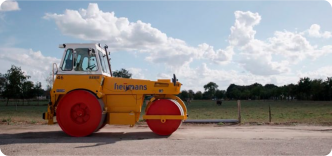
Heijmans achieved a European first in 2025, with the first fully self-propelled electric asphalt roller. This innovation is an important initial step in the automation of road construction, which is essential due to increasing staff shortages. The roller makes work smarter and safer, and is in line with our ambition to work emission-free.
The autonomous, electric roller runs based on instructions entered in advance, monitors the asphalt temperature and enhances the paving process to reduce the number of people required to lay the asphalt, which in turn improves safety and quality at the same time. The introduction of the self-propelled asphalt roller is the first step towards a fully self-propelled electric asphalt train consisting of a shuttle buggy, spreader and asphalt rollers.