Our people make the difference. At Heijmans, we are committed to creating a safe, inclusive and inspiring working environment in which everyone can grow. In this section, we focus on terms of employment, diversity and inclusion, safety and the growth of our staff. We promote equal opportunities and increase our power for innovation by strengthening teams and bringing amazing talents on board. Each and every employee makes a unique contribution to our shared success.
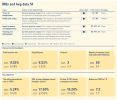
Our own workforce consists of ‘own employees’ and ‘non-employees’. The table shows, by topic, which group the information in this chapter relates to.
|
Own workforce |
||
|
Own employees |
Non-employees |
|
|
Impacts, policies, (remediation) actions and targets |
||
|
Terms of employment |
x |
|
|
Health and safety |
x |
x |
|
Equal treatment and opportunities |
x |
x |
|
Training and development |
x |
|
|
Metrics |
||
|
Own employees characteristics |
x |
|
|
Characteristics of non-employees |
x |
|
|
Collective labour agreement coverage and social dialogue |
x |
|
|
Living wage and social protection |
x |
|
|
Health and safety |
x |
x |
|
Remuneration |
x |
|
|
Incidents and complaints |
x |
x |
Impacts, risks and opportunities
In the reassessment, the impact relating to terms of employment has been revised. The positive impact on equal treatment and equal opportunities has been separated from terms of employment and identified as a separate topic. In 2024, terms of employment also included the opportunity to attract and retain talent through employee engagement. However, we see this as only a small part of engagement. That is why we turned this into a positive impact in 2025 by offering adequate terms of employment. In addition, the impact on health and safety has been reviewed, with the addition of a new positive impact in training and development.
Policy
The section 'Social information' describes the content of our policy documents. The impacts as defined in the DMA cannot be attributed to a single policy document; rather, they are embedded throughout the organisation. Below we briefly set out our vision on how the policy will be implemented.
Terms of employment, equal treatment and opportunities
Heijmans is a diverse company and employs people with different skills across a range of disciplines. Our staff are the driving force behind our organisation, and that is why we believe it is important that we offer good terms of employment. Good terms of employment help to create a pleasant working environment, yet we also hope they promote well-being outside the workplace. Heijmans has various CLAs in place that provide the foundation for this approach and which are supplemented by our own policy.
We believe that everyone should feel welcome at Heijmans. Diversity, inclusion and equal treatment are important subjects to us, and we are convinced that a diverse mix of people, of different ages and genders, only makes the organisation stronger. Less visible differences, including culture, beliefs, sexual orientation, character, talent and experience, also increase the versatility of our company. We have a programme focused on equal treatment and equal opportunities and are implementing actions to strengthen this further.
Training and development
Our own employees have different skills and educational backgrounds, and we want to make the most of them. We recognise that the market is changing, which includes an ageing population and shortages on the labour market. This requires innovation in how we carry out our work, but also support from our colleagues to grow further to make sure we are well prepared for the future. We see this as an important part of our strategy under the Team and Producibility pillars. Our staff handbook explains how we handle training and development at Heijmans.
Health and safety
Heijmans is committed to the human right to a safe, healthy working environment. We use the GO! programme (No Accidents), which consists of the GO! policy and the GO! app, to achieve this aim. GO! focuses on improving proactive safety conduct and guides our vision of safety.
Our policy focuses on preventing unsafe situations and accidents. That is not always possible, however, which is why we have also identified a negative impact here. We are raising our staff's awareness of safety through various programmes. We also want to improve our risk management and care, and are trying to make both more tangible using control measures.
How we involve our own employees in the process and decision-making
The Works Council is Heijmans' employee representation body. The Works Council[1] gathers input from our own employees through committees and workplace visits on a range of subjects, including those listed in the sustainability statement. Such input may also provide insight into satisfaction with our processes, policies and actions. and the signs are then shared with the Executive Board. The Works Council does not represent non-employees.
We strive to make the dialogue between our own employees and the Works Council as accessible as possible. For this purpose, the Works Council regularly visits the workplace to maintain direct contact. Once every two years, we measure the satisfaction of our own employees and non-employees using an engagement survey. We draw up reports based on age and gender while looking at potentially vulnerable groups. We omit other characteristics such as cultural background or physical disability due to privacy reasons. The engagement survey is a tool that allows us to monitor the extent to which the policies are adequate and any associated actions are effective. The engagement survey was conducted again in 2025. We achieved an eNPS score of +36 (2023: +35).[2] The eNPS score provides insight into overall employee satisfaction and, indirectly, into our social impacts. The slight increase in 2025 confirms that employees positively value our organisation, culture and way of working. The engagement survey also shows the extent to which colleagues understand, use and trust our processes. The results are discussed by each department and translated into specific improvement actions, which makes the survey a key part of monitoring and improving our social impact.
Actions
We turn our policy into actions to make a real difference. In this section, we set out actions on subjects that affect our own workforce. The actions listed were actively implemented in 2025.
Terms of employment
Terms of employment affect all areas of our organisation. The CLAs that apply to Heijmans represent the foundation of these conditions. We also offer additional arrangements to further improve the working conditions. We expect the actions to contribute to our positive impact. Below are a few examples:
|
Action |
Explanation |
Target group |
Time horizon |
|
Good home office |
We offer our employees the choice of a home office kit (desk and chair) or cash to furnish their home office. This regulation applies to all employees. |
Own employees |
Ongoing |
|
Additional allowances |
For certain groups of employees who work a lot at night and weekends and on call, we offer additional allowances. |
Own employees |
Ongoing |
|
Discount scheme |
We offer employees discounts from selected suppliers and when purchasing Heijmans homes. |
Own employees |
Ongoing |
|
Progress and career development interviews |
Discussions where personal development, safety and work are discussed. |
Own employees |
Ongoing |
We employ a large number of people and we want them to be engaged with the organisation and their colleagues. By offering additional working conditions, we improve their engagement and the terms of employment. Our agreements are set out in the staff handbook. Employees can also access our intranet to view the Code of Conduct, the reporting procedure for inappropriate behaviour, integrity and misconduct, and information about submitting anonymous reports through SpeakUp with ease.
Equal treatment
We firmly believe that everyone at Heijmans should be treated equally and should receive equal opportunities, and that it starts with promoting positive behaviour. This is embedded in our Code of Conduct. In the Diversity chapter of the Management Report, we describe in detail how we shape equal treatment within our organisation. We shed light on a number of actions that contribute to a diverse workforce and equal opportunities in the workplace.
|
Action |
Explanation |
Target group |
Time horizon |
|
Newcomer support |
We have a newcomer programme and a collaboration with King Willem I College. |
Own workforce |
Ongoing |
|
Diversity in recruitment |
When recruiting new employees, we take diversity into account. |
Own workforce |
Ongoing |
|
Starter programme |
We have a separate programme for starters with peer review and training. This also includes the trainee programme. Trainees perform multiple roles, after which they flow out to a position that suits them best. |
Own workforce |
Ongoing |
|
Coordination for students |
We have a student coordinator and a student recruiter. These persons deal with policy matters, the student programme and student recruitment. We want to attract young employees to increase diversity among our employees. |
Own workforce |
Ongoing |
In addition to our own actions, our staff can engage the services of Bouwend Nederland Social Support, where advisers offer a helping hand for a wide range of problems, including those outside the immediate working environment. Such issues include financial problems (debts), divorce or separation, social issues related to disability, illness and death, and personal or mental health issues (including those of family members). Where necessary, they refer people to relevant support organisations.
Training and development
At Heijmans, we are firm believers in the power of learning and development, which is why we work together to create an environment in which everyone can grow in a safe, healthy manner. Employees are able to take control of their own development with us and therefore contribute to Heijmans' development, too. The Heijmans Academy supports this approach by offering a wide range of (online) training courses. Employees can discuss their development needs with their manager at least once a year and draw up a development plan together. Training courses that suit an employee's growth path can then be selected from the Heijmans Academy catalogue. Employees are informed about the learning and development offer through their manager, with more information available on the intranet and in our HR system Workday. Below are a number of actions Heijmans offers to promote training and development:
|
Action |
Explanation |
Target group |
Time horizon |
|
Introduction of new programme for managers |
Through workshops, peer review and a central digital information environment, managers gain a clear picture within six months of what leadership at Heijmans entails and what is expected of them. This includes daily discussion of work and possible risks on the building site. |
Own employees |
Ongoing |
|
“Leaders of tomorrow” |
Talent programme for young professionals (approx. three years’ experience) focused on leadership development. |
Own employees |
Ongoing |
|
Leadership programme for change |
In the area of leadership, we have developed a curriculum that focuses on three core elements: onboarding new leaders, personal development of our people and translating strategy into concrete execution. |
Own employees |
Ongoing |
|
Trainee programme |
A training programme for starters at Heijmans. |
Own employees |
Ongoing |
Health and safety
Every new assignment we accept means an increase in health and safety risks for our own workforce. We know that our operations can have a direct impact on the well-being of our people and, as creators of a healthy living environment, we see a safe working environment as the foundation of our work. As such, we set safety requirements before we even start in order to reduce the operational risks. Furthermore, Heijmans has direct health and safety coordination over its own workforce and workers in the value chain (specifically on our own building sites). We always appoint a health and safety coordinator, who is on site during the agreed period and is responsible for all health and safety aspects related to the work. Below, we explain a number of actions. These actions are intended to mitigate negative impacts.
|
Action |
Explanation |
Target group |
Time horizon |
|
Daily start-up briefing |
Daily discussion of activities and possible risks on the building site on that day. |
Own workforce |
Ongoing |
|
Toolboxes |
Weekly meeting where changing topics are discussed, including safety risks and work instructions. |
Own workforce |
Ongoing |
|
Instructions |
The Heijmans GO! app contains instructions for various tasks and videos that promote safe conduct. |
Own workforce |
Ongoing |
|
Last Minute Risk Assessment (LMRA) |
Before starting work, an LMRA is expected to be carried out. The employee takes a step back and checks whether the work can be carried out safely. This covers unforeseen risks. There is no fixed format, but we emphasise performing the LMRA regularly. |
Own workforce |
Ongoing |
|
Provide personal protective equipment (PPE) |
Heijmans offers every employee who visits the building site the opportunity to order PPE. It is also possible to borrow them if an employee visits the building site less frequently. |
Own workforce |
Ongoing |
Heijmans is VCA[3]-certified, VCA-certified means that a Heijmans employee demonstrably meets the requirements for Safety, Health and Environment (SHE) in high-risk activities, through a VCA certificate at organisational level.
A Risk Inventory and Evaluation (RI&E) is also carried out at all Heijmans offices and building sites, and the associated Health and Safety Plan provides insight into the risks and actions. Prevention employees organise the occupational health and safety policy and provide regular reports on health and safety performance. In the event of an accident, a fixed procedure is followed and supported by an action list and online information through the GO! app and the website www.geenongevallen.nl. Detailed steps are set out for each incident, from assistance, investigation, action and handling, to act as a guarantee to prevent a recurrence.
Remedial actions
When an accident occurs that results in injury, a number of remedial actions are taken. We obviously provide first aid and call in emergency services when necessary. If an employee is no longer able to perform their role as a result of an accident, suitable alternative work is always sought. In addition, Heijmans offers absenteeism counselling, waiting list mediation and victim support if necessary. Our colleagues in the Safety department are closely involved in these procedures and their handling. We assess the effectiveness of the remedial actions provided for each incident. The lessons learned are included in the structural consultations that are planned between the Safety department and the operational management teams. Furthermore, if an employee is dissatisfied with the remedial actions, they may always submit a complaint using our reporting procedure. These complaints and reports are monitored by our confidential counsellors and the compliance officer. To test whether our own employees and non-employees are satisfied with our safety actions, this topic is also included in our biennial employee engagement survey.
Targets
A number of targets are linked to the material impact. The targets are set for one year (without a baseline year) and are monitored on a monthly basis. The results will be included in quarterly reports and discussed in management meetings. Management will then make any adjustments to the organisation where necessary. The targets are set by the Human Resources department and the Safety department, with the Works Council also involved to ensure that our employees' perspectives are included in this process.
|
Impact |
Target |
Explanation |
2025 |
2024 |
|
Terms of employment |
The rolling absenteeism rate in 2025 is a maximum of 4.95%. |
We want to prevent absenteeism because less absenteeism contributes to the well-being of our own employees and the continuity of the organisation. |
5.24% |
5.10% |
|
25% of our new colleagues came in through a referral.* |
The labour market is tight, which is why it is important to use different recruitment sources. A referral is one of the ways to find good candidates, which is why we want to increase inflow through a referral. We also see this as a measure of how satisfied our own employees are with Heijmans as an employer. |
17.50% |
23.55% |
|
|
Equal treatment and opportunities |
Of all our own employees, at least 15.75% are women. |
Gender is one of the priorities in diversity policy. We want to increase the number of women in the organisation. |
16.20% |
15.02% |
|
Health and safety |
Reduce the TRIR to 7.3 |
At Heijmans, we want to reduce the total number of accidents. The proportion of own and hired employees (S1) becomes visible in the TRIR. By actuating this, the TRIR will be reduced. We strive for continuous improvement. |
7.2 |
7.7 |
- *This target is not reported on the standalone entities Brabotech, van Gisbergen and Whoon.
In 2025, we did not set specific targets for training and development. as the subject became material in the DMA in 2025 for the first time. The actions are, however, monitored internally, and we can see how effective they have been in the results of the engagement survey and more.
Metrics
Heijmans has 6,222 employees (2024: 5,844). Our own employees all work in the Netherlands. In total, 594 employees left us during the year (2024: 525) and we recorded a staff turnover rate of 9.55% (2024: 8.98%). Throughout 2025, we had 938 FTEs non-employees.
|
Gender* |
Female |
Male |
Other |
Not stated |
Total |
|||||
|
2025 |
2024 |
2025 |
2024 |
2025 |
2024 |
2025 |
2024 |
2025 |
2024 |
|
|
FTE permanent employees |
860 |
753 |
4,952 |
4,738 |
2 |
1 |
0 |
0 |
5,814 |
5,492 |
|
FTE temporary employees |
23 |
20 |
149 |
138 |
0 |
0 |
0 |
0 |
172 |
158 |
|
On-call FTEs |
0 |
0 |
0 |
0 |
0 |
0 |
0 |
0 |
0 |
0 |
|
Total FTEs |
883 |
773 |
5,101 |
4,876 |
2 |
1 |
0 |
0 |
5,986 |
5,650 |
- *Gender as specified by the employee.
The reference date for our own workforce figures (own employees and non-employees) is 31 December 2025. The total number of FTEs differs from the financial statements. We also acquired Hegeman in December. Hegeman is not part of the information presented in the sustainability statement, resulting in a deviation of 172 FTEs. Further information on Hegeman’s reporting can be found in ' '.
The table below shows the gender distribution of our employees, further broken down by age. The total of this gender distribution differs from the total number of employees because the separate entity Brabotech is not included in this data point. The gender distribution of senior management can be found in the table ‘Executive Board’ and the table ‘Subtop’ in the chapter 'Diversity' in the Management Report.
|
Employees under 30 |
Employees between 30-50 |
Employees over 50 |
|
|
2024 |
716 |
2,888 |
2,240 |
|
2025 |
774 |
3,029 |
2,396 |
Remuneration
In 2025, we carried out a benchmark study to assess how our remuneration compares to the market. We log relevant personal data, such as gender, age, position and salary, in our records. Below we provide an insight into the difference in remuneration between men and women and the pay ratio between the median salary and the remuneration received by the best-paid employee.
|
2025 |
2024 |
|
|
Remuneration difference |
6.52% |
5.62% |
|
Remuneration ratio |
28.77 |
24.31 |
Representation and terms of employment
All Heijmans' own employees work exclusively in the Netherlands and are represented through a Dutch CLA. At Heijmans, we have four different collective labour agreements: the CLA for the construction and infrastructure sector, the CLA for technical installation companies, the CLA for the wholesale trade in building materials and the CLA for the carpentry industry. The business unit in which an employee works determines which CLA applies to the employee. Converted into a percentage, this means that 99.95% are covered by a collective labour agreement (2024: 99.98%). Trade unions such as the FNV and/or CNV are always present at the collective bargaining table for the various collective labour agreements. 100% of our employees are represented by our Works Council (2024: 95.6%). The Social Dialogue column relates to the Works Council's representation of employees.
|
CLA coverage ratio |
Social dialogue |
|||
|
Coverage range |
Employees - EEA* |
Employees - non-EEA** |
Employee representation*** |
|
|
0-19% |
- |
- |
- |
|
|
20-39% |
- |
- |
- |
|
|
40-59% |
- |
- |
- |
|
|
60-79% |
- |
- |
- |
|
|
80-100% |
Netherlands |
- |
Netherlands |
|
- *For countries with >50 employees representing >10% of total employees.
- **Estimate for regions with >50 employees representing >10% of total employees.
- ***EEA only, for countries with >50 employees representing >10% of total employees.
Through our policy, we aim to safeguard and improve human rights for all employees. We focus on suitable work, freedom of association, sustainable employability, holidays, actions to close the gender pay gap, works councils, collective labour agreements and policies in the area of absenteeism and reintegration. Dutch laws and regulations provide social protection against loss of income as a result of, among other things, unemployment, occupational accidents, non-congenital disabilities and parenthood. Furthermore, the CLAs set out additional provisions for events such as illness and retirement. All of our own employees work in the Netherlands and are subject to Dutch social security legislation.
We also want all our own employees to earn a living wage. That's why Heijmans always pays its own staff in accordance with the applicable CLA as a minimum. The wages in the CLAs are determined during the CLA negotiations by the employers' organisation and employees' organisations (unions). If the wage is insufficient, and below a government-determined limit, employees can also receive government benefits (such as healthcare and housing allowance) to achieve a living wage. In 2025, we paid all our own employees according to our definition of a living wage (2024: 100%).
Training and development
The overview below shows the average number of training hours and development interviews, broken down by gender. To safeguard anonymity, employees who do not identify as male or female are not included in this specific breakdown; given the small group size, the data could otherwise be traceable.
|
Male |
Female |
|
|
Average number of training hours |
14 |
9 |
|
Participation in career development interview |
73.41% |
69.22% |
Accidents and sickness
Our goal is zero accidents in the workplace. Almost the entire company is certified for Step 4 of the Safety Culture Ladder, which has a total of five steps. All of our workforce fall under the Heijmans management system for health and safety (2024: 100%).
Below we present the total number of accidents broken down into own employees, non-employees and workers in the value chain who carry out work on a building site, such as trainees and suppliers (hereinafter referred to as "other employees on the building site").
|
Critical performance indicator |
Own employees |
Non-employees* |
Other employees on the building site |
|||
|
2025 |
2024 |
2025 |
2024 |
2025 |
2024 |
|
|
Number of accidents** |
34 |
27.3 |
11.9 |
13.3 |
35.5 |
42 |
|
Number of fatalities |
0 |
0 |
0 |
0 |
1 |
0 |
- *In the accident register, up to and including 2024, we used the categories of “borrowers” and “subcontractors” (now other employees on the building site), whereby it was decisive who took care of management on the building site. From 2025, we will join the CSRD and look at the contractual agreement. Our own workforce: Our own employees and non-employees.
- **If an accident occurs in an associated company, we include our share. This results in decimal places.
The accidents resulted in 577 days' absence for all employee groups.[4] We use an accident rate as set out in the ESRS. As in the sector and in the Management Report, the IF rate is also presented as an entity-specific KPI.
|
Accident ratio |
2025 |
2024 |
|
Own employees |
3.5 |
2.9 |
|
Non-employees |
7.2 |
- |
|
IF figure |
3.0 |
2.3 ** |
- *In 2024, FTE was used for this calculation; the methodology was adjusted in 2025 and now looks at actual hours worked.
- **The IF figure for 2024 excludes Whoon and Van Gisbergen.
To determine recordable work-related ill health, we consider acute, recurring and chronic health problems caused or aggravated by working conditions, among other things. We use the list of occupational sicknesses of the International Labour Organisation (ILO) in doing so. In 2025, twenty occupational illnesses among our own employees were registered with our company doctor (2024: 28).
Incidents and complaints
If a report is received concerning integrity issues or inappropriate behaviour, the Executive Board first assesses the nature and seriousness of the matter, after which a fact-finding investigation is conducted. Such reports can lead to written warnings, including final warnings, and more. All reports are also discussed (and anonymised where necessary) in Supervisory Board meetings and assessed afterwards with the managers involved.
Reports are logged under different categories, These may include reports relating to bullying, inappropriate behaviour, personal issues and discrimination. Reports relating to discrimination are recorded separately.
|
2025 |
2024 |
|
|
Reports of integrity issues and undesirable conduct |
59 |
54 |
|
Of which discrimination |
0 |
3 |
In 2025, this led to €0 in fines, penalties and damages (2024: €0.)
Reporting requirements
|
Reporting requirements |
KPI definition |
Methodology |
Assumptions |
Limitation |
|
|---|---|---|---|---|---|
|
Entity-specific KPI: eNPS score |
eNPS score. |
The score is calculated externally in accordance with the European eNPS standard and is part of our engagement survey. It is measured using the following question: How likely are you to recommend Heijmans as a good employer to others? |
No assumptions are made for calculating this data point. |
This data point is not calculated for one of our independent subsidiaries (1.03% of our own employees). |
|
|
Objective colleagues with referral |
Of our new colleagues, 25% came in via referral. |
New employees are asked how they came to work at Heijmans. Employees can recommend potential candidates. At the end of the year, we check our records to see who joined the company in this way. |
We assume that everyone who refers a new colleague receives the referral bonus. |
This data point excludes our independent subsidiaries (5.11% of our own employees). |
|
|
Target male-female ratio |
Of all our own employees, at least 15.5% are women. |
Based on total numbers (as reported according to S1-6), we look at how many of the total number of our own employees are women. |
We use the gender specified by the employee themselves. |
There are no restrictions on calculating this data point. |
|
|
TRIR target |
Reduce the TRIR to 7.3. |
We generate a printout from the incident register of the total number of reports, filtering categories as specified in the definition. The subsidiaries have their own records, but record the same categories. We calculate a ratio: the number of lost time accidents in relation to our own employees and non-employees. |
If an accident occurs in an associated company, we include our share. This figure also includes our interns. Hours worked are recorded by us, and we maintain the classification if it can be traced back to 31 December 2025. |
It is possible that an incident occurs and that an employee/worker does not report it. |
|
|
Target rolling absenteeism rate |
The rolling absence rate in 2025 will be a maximum of 4.75%. |
The absenteeism rate is calculated as follows: the total number of days absent in a month divided by the potential available days in a month. This number is multiplied by 100%. |
There are no assumptions when calculating this data point. |
In 2024, the subsidiaries were not included in the absenteeism rate. In 2025, 0.37% of employees will not be included. |
|
|
S1-6 |
50 (a) |
Total number of own employees, broken down by gender and country. |
Total number (headcount) of staff: [total number of men in the Netherlands] + [total number of women in the Netherlands] + [total number of other in the Netherlands]. This information is consolidated from the HR systems used within Heijmans. |
We use the gender as indicated by the employee's own. |
There are no restrictions on calculating this data point. |
|
Reporting requirements |
KPI definition |
Methodology |
Assumptions |
Limitation |
|
|---|---|---|---|---|---|
|
50 (b) i. |
Total FTE permanent employees broken down by gender. |
Total FTE on permanent contract: [total FTE men] + [total FTE women] + [total FTE other]. |
We use the gender as indicated by the employee themselves. |
There are no restrictions on calculating this data point. |
|
|
50 (b) ii. |
Total number of temporary employees, broken down by gender. |
Total FTE on temporary contracts: [total FTE men] + [total FTE women] + [total FTE other]. |
We use the gender as indicated by the employee's own. |
There are no restrictions on calculating this data point. |
|
|
50 (b) iii. |
Total FTE on-call workers, broken down by gender and country. |
Total fte on-call workers: [total fte male on-call workers] + [total fte female on-call workers] + [total fte other on-call workers]. |
We use the gender as indicated by the employee themselves. |
There are no restrictions on calculating this data point. |
|
|
50 (c) |
Number (headcount) and percentage of employee turnover in the reporting period. |
Percentage employee turnover in the reporting period (based on headcount): [total number of people who left Heijmans in 2025] / [total number of own employees as at 31-12-2025] . |
No assumptions are made for calculating this data point. |
There are no restrictions on calculating this data point. |
|
|
S1-7 |
55 (b) i |
The total/average number of non-employees. |
The number of non-employees is calculated on the basis of FTEs. This is determined on the basis of the number of hours worked and declared. The number of hours worked by non-employees is determined on the basis of the hours recorded in the time registration system; non-employees declare their hours to an external party. |
The subsidiaries Whoon and Van Gisbergen do not use an expense claim system for this group of employees; instead, we use invoiced hours. |
In this data point, 0.37% of employees are not included. |
|
S1-8 |
60 (a) |
Percentage of own employees covered by a collective labour agreement. |
Percentage of CAO coverage = [own employees' CAO Construction and Infra + own employees' CAO Technical Installation Company + own employees' CAO Hibin + own employees' CAO Carpentry Industry] / [total number of own employees]. |
No assumptions are made for calculating this data point. |
There are no restrictions on calculating this data point. |
|
60 (b) |
Percentage of collective labour agreement coverage per country. |
Percentage of collective labour agreement coverage is calculated as specified in DR 60 (a). We break this down by country, in our case only the Netherlands. |
No assumptions are made for calculating this data point. |
There are no restrictions on calculating this data point. |
|
|
Reporting requirements |
KPI definition |
Methodology |
Assumptions |
Limitation |
|
|---|---|---|---|---|---|
|
63 (a) |
Percentage of own employees with employee representation. |
Percentage of own employees with employee representation: [own employees with employee representation] / [total number of own employees]. |
By active representation, we mean the departments or teams at Heijmans that actively receive a call to register for the Works Council when (re)elections take place. |
There are no restrictions on calculating this data point. |
|
|
S1-9 |
66 (a) |
The number and percentage of men and women in Heijmans' senior management. |
Number (headcount) of men and women within senior management of Heijmans: [men within senior management of Heijmans] / [total number of senior management] and [women within senior management of Heijmans] / [total number of senior management]. |
No assumptions are made for calculating this data point. |
There are no restrictions on calculating this data point. |
|
66 (b) |
Distribution of own employees by age group. |
Distribution of own employees by age groups: [number of employees] and [age], taken from HR systems. |
No assumptions are made for calculating this data point. |
This data point does not include 0.37% of the company's own employees. |
|
|
S1-10 |
70 |
Living wage. |
Based on the collective labour agreement, contract type and age, we determine whether our own employees are paid in accordance with the collective labour agreement. |
No assumptions are made for calculating this data point. |
This data point does not include 0.37% of the company's own employees. |
|
S1-11 |
74 |
Social protection against loss of income. |
This is laid down in Dutch legislation and regulations. We check data point DR 50 (a) to see whether all employees are located in the Netherlands. |
No assumptions are made for calculating this data point. |
There are no restrictions on calculating this data point. |
|
S1-13 |
83 (a) |
Percentage of own employees participating in appraisal and career interviews. |
The number of own employees who participated in assessment and career interviews is recorded in the HR administration. |
No assumptions are made for calculating this data point. |
This data point does not include 0.37% of the company's own employees. |
|
83 (b) |
The average number of training hours per employee, broken down by gender. |
The number of training hours is determined on the basis of the number of training courses registered in the HR administration and the corresponding standard hours per training course. |
The standard hours per training course are determined based on the information provided by the training provider. |
This data point does not include 0.37% of the company's own employees. |
|
|
S1-14 |
88 (a) |
Percentage within own employees covered by health and safety management system. |
The Heijmans safety policy applies to everyone. |
No assumptions are made for calculating this data point. |
There are no restrictions on calculating this data point. |
|
Reporting requirements |
KPI definition |
Methodology |
Assumptions |
Limitation |
|
|---|---|---|---|---|---|
|
88 (b) |
Number of deaths due to occupational accidents and diseases of other employees working at the company's premises. |
The number of fatalities is recorded in the incident system, which is a separate category within the safety dashboard. |
No assumptions are made for calculating this data point. |
The deaths of 0.37% of employees do not fall under the category of 'own employees', but under 'subcontractors'; this concerns an independent subsidiary. |
|
|
88 (c) |
Number of reportable occupational accidents. |
We generate a printout from the incident register of the total number of reports, filtering categories as specified in the definition. The subsidiaries have their own administration, but record the same categories. |
If an accident occurs in an associated company, we include our share. We place accidents involving trainees in the category 'other employees on the building site'. Hours worked are recorded by us, and we maintain the classification if it can be traced back to 31 December 2025. |
It is possible that an incident occurs and that an employee/worker does not report it. |
|
|
Reporting requirements |
KPI definition |
Methodology |
Assumptions |
Limitation |
|
|---|---|---|---|---|---|
|
88 (d) |
Number of cases of occupational diseases among own employees. |
The number of reports to the company doctor is obtained from the relevant occupational health and safety service. |
No assumptions are made for calculating this data point. |
For non-employees, this information is not available from the company doctor. This group does not visit the Heijmans company doctor, but if there is a specific case of occupational disease in the workplace, HR and K&V will include it in the occupational disease reporting procedure as described in the personnel handbook. |
|
|
88 (e) |
Number of days of absence due to injury and death. |
As soon as an employee makes a safety report, it is classified into different categories of absence. For the 1-5 days absence category, we count 5 days, for the 5-14 days category we count 14 days, and for 15+ days we count 15 days. We multiply the number of days by the number of incidents. This is only possible for the LWC category (accident with absence). This means that no estimate is made for the other categories (FAT, SILT, SILA and RWC), which account for 25.4%. |
If an accident occurs in an associated company, we include our share. |
It is possible that an incident occurs and that an employee/worker does not report it. |
|
|
Entity-specific KPI: IF figure |
IF score. |
We generate a printout from the incident register of the total number of reports, filtering categories as specified in the definition. The subsidiaries have their own records, but record the same categories. |
If an accident occurs in an associated company, we include our share. This figure also includes our interns. Hours worked are recorded by us, and we maintain the classification if it can be traced back to 31 December 2025. |
It is possible that an incident occurs and that an employee/worker does not report it. |
|
|
Reporting requirements |
KPI definition |
Methodology |
Assumptions |
Limitation |
|
|---|---|---|---|---|---|
|
S1-16 |
97 (a) |
Gender pay gap (%). |
Pay gap = [average gross hourly wage M] - [average gross hourly wage V] / [average gross hourly wage M]. |
No assumptions are made for calculating this data point. |
This data point does not include 0.37% of the company's own employees. |
|
97 (b) |
Remuneration ratio (not including the best paid person). |
We obtain the information for this KPI from our personnel and payroll records with a reference date of 31 December 2025. The annual remuneration per employee is calculated on the basis of gross salary including all allowances and remunerations. The highest-paid person is the CEO; for this, we use the total package of remuneration received by the CEO. This is explained in detail in the management report and the remuneration report. |
No assumptions are made for calculating this data point. |
This data point does not include 0.37% of the company's own employees. |
|
|
103 (a) |
The number of incidents relating to discrimination, including undesirable conduct, in the past reporting period. |
The number of incidents related to discrimination: [reports within the discrimination category, as reported to the Risk Office for FY2025]. |
No assumptions are made for calculating this data point. |
There are no restrictions on calculating this data point. |
|
|
103 (b) |
The number of complaints submitted through channels for individuals within Heijmans own employees to raise concerns (including grievance mechanisms). |
For the 2025 financial year (and before), confidential counsellors report all reports they receive to the compliance officer. The statement to the compliance officer contains the numbers per category (nature of the) report. The compliance officer provides a quarterly report of the number of reports (to the compliance officer and confidential counsellors combined) to the Risk Office for the quarterly CRO report. During 2025, colleagues at Van Gisbergen could also report to the company's management. |
No assumptions are made for calculating this data point. |
There is a restriction only when a colleague fails to report an incident to Heijmans. |
|
|
103 (c) |
The total amount of fines relating to reported incidents and complaints. |
As soon as a fine is imposed, we add up the amounts in euros to arrive at a total amount. |
No assumptions are made for calculating this data point. |
There are no restrictions on calculating this data point. |
|
- 1Our Works Council has not signed a Global Framework Agreement or any other agreement on human rights.
- 2Van Gisbergen was not included in the engagement survey.
- 3Health, Safety and Environment Checklist for Contractors.
- 4This absence has been estimated based on the accident categories. We do not record the exact absence related to accidents; this means that no estimate is made for 25.4% of accidents.