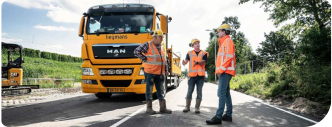
Healthy growth, but not at the expense of our people
There is more work in the construction sector than we can manage. There is confidence in the industry and, as creators of a healthy living environment, we can make a valuable contribution to a better Netherlands. As a company, we want to grow, but we want to do so responsibly, too. That sometimes presents a challenge, particularly in the world of infrastructure. The scope often changes during ongoing projects, while the original deadlines remain unchanged. We are also often faced with unforeseen circumstances when it comes to replacement and renovation projects. This in itself creates pressure – how do you keep teams motivated when the work levels increase, but deadlines stay the same? And how big a buffer do you build in for replacement and renovation works when you know there are even more clients waiting in the pipeline?
That sometimes presents a challenge, particularly in the world of infrastructure. The scope often changes during ongoing projects, while the original deadlines remain unchanged. We are also often faced with unforeseen circumstances when it comes to replacement and renovation projects. This in itself creates pressure – how do you keep teams motivated when the work levels increase, but deadlines stay the same? And how big a buffer do you build in for replacement and renovation works when you know there are even more clients waiting in the pipeline?
We want to grow in a way that is healthy and sustainable. This means we look out for our people, pay attention to the quality of our work, and look after the living environment we create together. Our response to this is that we are investing heavily in 'working smarter' and innovation.
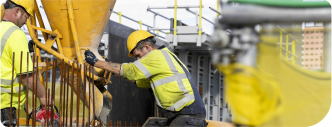
Large-scale construction and accelerating sustainability do not go hand in hand
Heijmans wants to lead the way in sustainability in the construction sector, with investments in emission-free equipment, biobased solutions and circular materials.
The construction industry is facing the challenge of combining speed and affordability with sustainability. Sustainable alternatives are not always sufficiently available or cost-effective, while clients demand speed and affordability. As a result, demand for materials such as concrete continues to play a major role for the time being. Concrete, however, continues to be one of the largest sources of carbon emissions. This means the need to build quickly collides with the climate challenge facing us as well as with the limited availability of feasible, affordable sustainable materials.
The ambitions of sustainable construction and building on a large scale do not therefore go hand in hand. How do we find the balance between speed, affordability and reducing carbon emissions? And how do we create an equal and consistent playing field in which government, clients and value chain partners move in the same direction to ensure that investments in sustainability can pay off, and the sector can accelerate at the same pace? The government can play a crucial role here by setting clear frameworks and ensuring sustainable procurement in tenders.
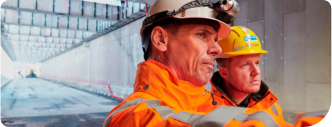
Building in a country struggling with the challenge of too much and too little water
We face an urgent challenge in the Netherlands: how do we ensure that our country can cope with excess water while having sufficient water available in times of drought? We are seeing periods of heavy rain and prolonged drought alternating with each other, which affects our living environment. This makes the subject of water an important one for Heijmans in all its projects and developments.
At the same time, we want to solve the housing shortage by building as much as possible, which necessitates choices that ensure both the availability and quality of water. As creators of healthy living environments, we are actively looking for solutions that contribute to sufficient, safe and clean water – and we work closely with our partners in this regard.
This consideration is becoming increasingly complex in area developments. Not every location is as suitable as another for development; some areas are low-lying and vulnerable to flooding, others areas are higher up and vulnerable to drought. There are also areas that present opportunities for water-resistant developments. The key question is therefore not whether or not we should build in certain areas, but how we carefully assess, for each location, what is prudent and responsible — both in addressing the housing shortage and in creating a future-proof living environment. The choices we make today and how we look at dilemmas to arrive at integrated solutions will determine what the Netherlands will look like in the future.
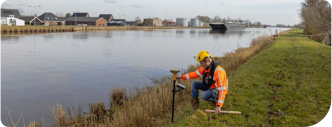
Is generative AI something to explore or accelerate?
Generative AI offers Heijmans significant opportunities to work smarter, faster and better. It increases productivity, improves the quality of analyses and supports employees in their daily work – from writing and visualisation to automation and programming. Employees are increasingly embracing these opportunities. That's why we, as an organisation, are investing in targeted support to make sure everyone can use AI safely and responsibly.
At the same time, adopting generative AI also has its downsides, as embracing new tools doesn't come easily to everyone. What's more, AI can affect the human side of our work, as some colleagues see it as unethical, distant or less meaningful. The technology also brings with it new responsibilities and risks, such as data security, privacy, ethics and the impact on work and craftsmanship. Developments are also happening at breakneck speed, which means they need to be handled carefully and with constant attention.
The key consideration to weigh up is whether we embrace the high pace of AI innovation straight away, or whether we first set the frameworks and analyse the risks thoroughly afterwards. After all, we don't know how secure AI will be in the long term, what will happen to our data and how it will affect our long-term sense of purpose and job satisfaction. The use of AI also requires a lot of energy. This raises the question of how these factors sit alongside our role as a builder of a healthy living environment and the development of sustainable innovations.
It is up to us to leverage the benefits of AI wisely, embrace the opportunities of working smarter and faster while continually analysing risks, without losing sight of humanity, ethics and sustainability.

Working safely requires the courage to intervene
We work safely or we do not work at all. At Heijmans, staying safe and healthy at work always takes precedence over time and money. However, adopting this approach on a daily basis isn't always easy in practice. Employees can find themselves between a rock and a hard place, in that they see an unsafe situation but at the same time feel pressurised to carry on because of their commitment to the team, because they want to keep to agreements made with the client, or because they fear that stopping will cause delays and run up costs.
How do you balance progress and clients' interests with safety, knowing that safety must always come first? Safety goes beyond rules or procedures. It requires a culture where everyone feels they have the support to say: "Stop, this isn't safe". Where it is natural to talk to each other without anyone feeling they are carrying a burden. And that takes courage.
Safety requires consistent behaviour and good leadership. Talking about safety is all well and good, but we also have to comply with all the rules. That's why we need to actively steer the issue of safety, with leaders who always set a good example, who do not look the other way and who consistently check and call for complete compliance with safety instructions. Thorough, frequent project consultations contribute here by setting out expectations, making risks a topic for discussion and considering each other in the challenges that lie ahead.
We can't do this alone. As a pioneer in safety, Heijmans wants to work towards a different mindset across the sector as a whole. Partners and subcontractors should embrace the same safety standards and feel that they can stop work if required. Only then can we work together in a safer environment.