The construction sector is a major contributor to the loss of biodiversity. Heijmans recognises this impact and the risks that further deterioration entails for nature, society and the economy. As such, biodiversity forms a core part of our sustainability strategy alongside climate and water. We are striving to become a nature-positive company and leave our living environment better than we found it. Our ambitions are clear – reduce negative impacts, identify dependencies and risks, and seize opportunities. We use analyses to adapt our policy and project approach, take nature-positive actions and set specific goals. As an example, we work to limit the loss of nature, restore ecosystems and achieve a positive impact on nature.
Impacts, risks and opportunities
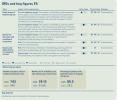
In 2025, we reassessed the and went even further. Whereas in 2024 there was one negative impact across the entire value chain, we have now defined impacts for each group in the value chain. In addition, the analysis has been expanded to include two new risks and one opportunity.
Biodiversity analysis
Heijmans started mapping out its impacts, dependencies, risks and opportunities with regard to biodiversity and ecosystems in 2024. This process is based on the LEAP approach by the Task Force on Nature-related Financial Disclosures (TNFD). The LEAP approach is a step-by-step approach based on Locate, Evaluate, Assess and Prepare. In parallel with this analysis becoming more mature, work is ongoing on an increasingly comprehensive resilience analysis. In 2025, the first tests were carried out using Thrive, a tool developed by Naturalis and others to provide insights into biodiversity.
We will look at whether we can use this tool more widely in 2026 to obtain more qualitative data on biodiversity in our projects. Until there is greater clarity, Heijmans assumes that its strategy and business model are vulnerable to the various risks associated with the loss of biodiversity and ecosystems, and that its resilience has not yet been adequately assessed at governance level. At this stage, Heijmans is not yet adjusting its business model based on the outcomes of the impact, dependency, risk and opportunity analysis.
Heijmans operates in many different locations and works with many different suppliers and clients, which leads to complex nature-related dependencies and impacts. In order to create a manageable starting point, we opt for a defined scope focusing on a small number of locations and high-priority sections of the value chain, where significant nature-related dependencies, impacts, risks and opportunities are expected to occur. Combined with data from our own operations, this provides a solid basis for analysis and allows us to focus on the areas in which we can actually make an impact. The scope of the analysis is adjusted each reporting year based on the capacities and data available. This approach allows Heijmans to gradually expand the breadth and depth of the analysis as the organisation gains more experience and maturity in applying this process. At the same time, we recognise that communities that depend on biodiversity and ecosystem services may already be affected. To support these potentially affected communities, Heijmans wants to engage in dialogue about the sustainability analyses and discuss when mitigating actions may be required to reduce impacts.
We made the following assumptions for this analysis:
-
The locations identified as material provide an accurate and representative picture of Heijmans’ business model in its direct operations.
-
The time horizon to which this analysis applies is the current financial year. Heijmans assumes that 2025 is representative of an average financial year in which Heijmans carries out its usual economic activities.
-
The WWF Risk Filter tool provides an accurate assessment of risks related to our locations, using the most up-to-date and best available data.
This resilience analysis currently does not include external stakeholders in direct operations.
Results
We have linked economic activities to our projects using the ENCORE database. We apply a materiality score of 2.5 and above (which differs from the threshold used by ENCORE itself). Based on this filtering, this year there are 743 projects[1] close to biodiversity-sensitive areas that, according to ENCORE, have potential material negative impacts on biodiversity, ecosystems and natural habitats.
This may result in a deterioration of the relevant habitats and Heijmans' activities disturbing animals in protected areas. The total area of all potential material surface locations together amounts to approximately 28.10 km2 (2024: 23.88 km2)[2]. The methodology can be found in the Reporting requirements table. We have identified a material impact on land degradation, desertification and soil sealing in Heijmans' economic activities. This can also be seen in our IRO. Furthermore, Heijmans has also identified a potential effect on endangered species from the results in the IBAT tool. In 2025, it was established that at 85.5% of the 723 locations analysed in the IBAT tool, the potential impact on endangered species is significant.
We want to further clarify the actual impact in the coming years, and will use the LEAP approach to do so. We need to be able to assess the impact on more of a project-specific basis, as the project activities and areas are very diverse. From 2026, we will start carrying out analyses on a structural basis to map biodiversity at project level. which will ultimately allow us to clarify the impact more specifically, formulate and take appropriate control measures, report on our target and adjust our long-term business model where necessary.
Resilience
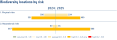
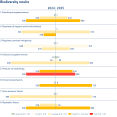
Once again this year, we are using the WWF Risk Filter tool to plot the locations from the impact and dependency analysis. We have not yet incorporated the results into our policies or actions. A total of 723 projects have been uploaded to the tool; 20 projects are not included in this analysis. The analysis provides insight into the physical and transition risks related to ecosystem services. It does not yet provide insights into the systemic risks to which Heijmans' business model is subject or its resilience in relation to such risks. The results are shown below, broken down by type of risk and associated risk categories.
Policy
Heijmans operates according to the principle 'We give back more than we take'. This means that, among other things, we strive to have a net positive impact on nature. Our biodiversity policy features sections on 'Improving biodiversity' and 'Nature as a solution'.
The current policy is based on scientific insights and international frameworks, such as the Kunming-Montreal Global Biodiversity Framework and the EU Nature Restoration Law. Our policy has been written with the entire value chain in mind, but implementation is only focused on the company's own operations[3] at this time. The Biodiversity Policy[4] is available on our website rapportage.heijmans.nl.
Improving biodiversity
Heijmans enhances biodiversity through four strategic impact factors that align with our business model and strategy. We recognise that our activities have a negative impact on biodiversity and ecosystems and therefore on the communities that depend on them, while our insights into the extent of the impact remains limited. However, an integrated monitoring system that measures our total impact, including the value chain, is still under development, and market standards do not yet offer a suitable solution. Our policy aims to limit the negative impacts and make a positive contribution wherever possible.
Space for nature
Reducing the space for nature places huge pressure on biodiversity. Infrastructure, agriculture and construction have all played a role in the disappearance of nature. Heijmans' business operations contribute to changes of land use, which is a direct pressure factor on biodiversity. In our value chain, this can also lead to effects such as land degradation, desertification and soil sealing.
We do not see a large-scale negative impact in our own operation; however, we do see a risk of land degradation and soil sealing. We therefore strive to protect nature and improve it where possible in projects and activities bordering outdoor areas.
Species richness
As a general rule, a greater variety of species and ecosystems contributes to a better balance in nature. Here the focus lies on native species present in the Netherlands' nature landscape. Invasive exotic species, on the other hand, are species that were not present in the Netherlands and often spread quickly. Such species can displace native species and harm biodiversity as a result. Heijmans is committed to the sustainable management of ecosystems within its projects and activities. In doing so, we aim to restore, regenerate and improve the original biodiversity. In projects that present a risk of the spread of invasive exotic species, we take a careful approach in order to prevent such a spread.
Environmental conditions
Healthy soil, clean water (see the ‘Water Matters’ policy on our website rapportage.heijmans.nl ) and clean air form the foundation of an ecosystem in which people, animals and plants can thrive. Pollution of these domains, among other things, undermines biodiversity. Climate change and nitrogen emissions, in part caused by construction activities, are only increasing this pressure. Our vision on this topic is explained in more detail in the Climate chapter. Heijmans limits emissions by applying innovative methods and tools, one of which is the mitigation ladder. We pursue a sustainable land lease policy and, together with Wageningen University & Research, are developing a framework for sustainable soil management, aimed, among other things, at preventing land degradation.
Nature as a resource
Construction requires raw materials. We can reduce this demand by focusing on circular designs and reusing materials. In addition, we are also focusing on responsible production and limiting the use of primary raw materials. Placing the focus on the nature-inclusive, regenerative and sustainable use of natural resources can limit the negative impact on biodiversity.
Our vision on materials and their traceability, including timber and deforestation, is set out in the chapter Resource use and circular economy .
Nature-based solutions
Heijmans is highly dependent on ecosystem services, which poses a risk to the continuity of our business operations. At the same time, we also see the responsible use of these services as an opportunity to add greater value to our buildings and their surroundings. We leverage and improve these services in order to future-proof our projects and value chain. There are four key dependencies:
Inspiration
Our innovative strength is based on learning from nature. Biomimicry (learning from nature) and green integration increase the ability to stand out, increase (sales) and purchase values, and create healthy living environments.
Resilience
Our cities and infrastructure are vulnerable to climate change. Fossilisation leads to flooding during extreme downpours and dangerous heat stress in the summer. We use natural solutions to reduce flooding, heat stress and climate damage. In so doing, we extend the lifespan and protect the safety of our assets and buildings, as well as making them more pleasant for end users.
Health
Air pollution and noise pollution represent threats to a healthy living environment and can cause health problems. Green buffers and vegetation improve air quality, reduce noise and create a pleasant living climate. The success of our projects depends on natural elements that reduce the negative effects of urbanisation and promote well-being.
Production
Our processes and materials rely on natural productivity. We need clean water for our construction processes, our employees count on a stable food supply that relies on pollination and fertile soil, and our biobased materials such as wood and fibres are fully dependent on healthy, productive ecosystems.
The stability of our supply chain as a whole and the economy in which we operate rests on this natural productivity.
Actions
Although Heijmans does not specifically use the mitigation ladder as a tool, each action can be categorised using this ladder, which is a step-by-step plan to minimise negative impacts on nature.
The steps are as follows:
-
Avoid
-
Minimise
-
Rehabilitation and recovery
-
Compensation
Heijmans frequently uses nature-based solutions in its projects and area developments. These solutions focus on the use of natural processes and ecosystems to contribute to climate adaptation, biodiversity recovery, improving nature and the well-being of communities. By combining technical knowledge with ecological principles, Heijmans creates social, economic and ecological value. We do not currently use biodiversity compensation, such as biodiversity certificates, to repair our impact.
Heijmans is actively working to make cross-project actions more accessible to everyone at the company. To this end, we developed in 2025 an app containing a catalogue of actions that can be taken during a project. These may be large-scale actions, such as creating wildlife passages or a natural windbreak, but it could also involve small actions such as leaving leaves in place on the ground or removing tiles (replacing paving with green areas). The app allows our employees to see the added value of an action for 'Improving biodiversity' and 'Nature-based solutions' at a glance.
The app will be launched and further developed in 2026. The table below highlights several actions in the categories 'Measurement instruments', 'Partnerships' and 'Research programmes':
|
Action |
Explanation |
Mitigation hierarchy |
Policy link |
Value chain |
Time horizon |
|
|
Measurement instruments |
BioBuddy |
Development of new technology to measure biodiversity using sensors and Artificial Intelligence (AI). |
Avoidance and rehabilitation & restoration |
Species richness |
Own operations (some projects) |
Indefinite, ongoing measure |
|
Nature Ladder (Natuurladder) |
Measuring instrument that assesses the maturity of the topics of biodiversity and climate adaptation based on Culture, Leadership and Content. The tool will be used in all category 2 & 3 projects of Infra and construction teams. |
Avoidance, minimisation and rehabilitation & recovery |
Space for nature, Species richness, Environmental conditions |
Own operations (all category 2 & 3 projects of Infrastructure and Construction teams) |
Indefinite, ongoing measure |
|
|
NL Area label |
We apply the NL Area Label within Heijmans, which has a component focused on biodiversity. The label combines up-to-date professional knowledge of ecology and use of materials with state-of-the-art applications in the field of geodata and digitisation. |
Minimisation |
Space for nature, Species richness, Environmental conditions, Nature as a solution |
Own operations |
Indefinite, ongoing measure |
|
|
Partnerships |
Collaboration with Staatsbosbeheer |
Collaboration with Staatsbosbeheer (the Dutch Forestry Commission) and Stichting Nationale Boomfeestdag (National Tree Day Foundation), aimed at promoting biodiversity outside the planning boundaries by planting 24 hectares of forest by 2030. This will ensure the absorption of greenhouse gases and provide opportunities for education and increasing the involvement of children. |
Rehabilitation & recovery |
Space for nature |
Own operations |
2030 |
|
Collaboration with Naturalis |
The collaboration focuses on making biodiversity measurable. This relates to both embedding biodiversity targets in business operations and actual biodiversity in the field. |
Rehabilitation & recovery |
Species richness |
Own operations |
Indefinite, ongoing cooperation |
|
|
Research programmes |
Research with Wageningen University - UrbiSoil |
The research focuses on developing a uniform measuring instrument to assess the biological status of soil (in an urban environment). |
Avoidance and rehabilitation & recovery |
Environmental conditions |
Own operations |
2025 to 2027 |
|
Research project with Amsterdam University of Applied Sciences, NWO - KIC Lizard |
This project focuses on climate-optimised, nature-based facades for heat resistance of buildings, both inside and outside. |
Rehabilitation & recovery |
Space for nature |
Own operations |
2025 |
|
|
Research project with Naturalis – Hidden Biodiversity |
Hidden Biodiversity is a four-year research programme with a broad consortium that investigates the presence of 'hidden biodiversity' in the city with the aim of giving it a place in policy and management. |
Avoidance, minimisation and rehabilitation & recovery |
Space for nature, Species diversity |
Own operations |
2022 to 2025 |
Targets
Our targets are currently well aligned with various international frameworks. The most important is the Kunming-Montreal Global Biodiversity Framework (GBF), which consists of 23 targets to combat the worldwide decline of biodiversity and ecosystems. Heijmans' targets are linked to the various biodiversity pillars and contribute to ten of the GBF's 23 targets. No ecological thresholds were applied when drawing up the targets. We recognise the importance of this and are exploring how we can integrate these concepts effectively to improve our contribution to conserving biodiversity and ecosystems. In addition, the targets have been set without being aligned with stakeholders and local communities.
Our targets focus on reducing the impact on biodiversity, which corresponds to the 'Minimise' step on the mitigation ladder. We do not currently report on these targets, as we launched the first tests to measure these targets in 2025. We expect to be able to share the initial findings in the annual report from 2026. The table below sets out the strategic targets:
|
Impact factor |
Target |
Link to IRO |
Metric |
Unit |
|
Space for nature |
From 2030 onwards, every project that is actually implemented will add net surface area to nature. |
This is an attempt to reduce the negative impact of land use. |
Percentage of projects found to add natural areas. |
Square metres of nature added (both horizontally and vertically) per project. |
|
Species richness |
From 2030 onwards, every materially viable project will contribute to an increase in species diversity. |
By doing so, we try to reduce the negative impact around the introduction of invasive species. |
Percentage of materially found projects that add biotopes. |
Number of biotopes (living environments) added per project. |
|
Environmental conditions |
No specific biodiversity target has yet been set. However, the climate targets will contribute to this. |
To be determined. |
N/A |
N/A |
|
Nature as a resource |
No specific biodiversity target has yet been set. However, circularity and use of materials targets do contribute to this. |
To be determined. |
N/A |
N/A |
Reporting requirements
|
Reporting requirements |
KPI definition |
Methodology |
Assumptions |
Limitation |
|
|
SBM-3 |
16 (c) |
Potential impact on endangered species. |
In the results of DR 35, the IBAT tool also provides an estimate of the percentage of projects that have a potentially negative impact on endangered species. |
No assumptions are made for calculating this data point. |
There are no restrictions on calculating this data point. |
|
E4-5 |
35 |
Number of business sites located in or near biodiversity-sensitive areas and adversely affecting them. |
All projects and sites of Heijmans active during 01-01-2025 to 31-12-2025 are linked to the principles of https://www.encorenature.org/en database based on biodiversity impacts and dependencies, and economic activity. The IBAT tool https://www.ibat-alliance.org/ is used to calculate the surface area of the locations remaining from the materiality analysis. |
We determine an active project based on a turnover threshold for the project. |
|
|
Area of business sites located in or near biodiversity-sensitive areas and negatively affecting them. Area expressed in square kilometres. |
For infrastructure projects, we select the 10 projects with the highest turnover and use GIS data and construction drawings to determine their surface area. For utility projects, we select five large projects and use the surface area from the construction drawings to determine the surface area. For our housing projects, we make an estimate based on the number of homes. We estimated the number of dwellings per hectare for inner-city housing development category, outer-city housing development including area development and excluding area development based on a sample . |
We assume that our sample is representative of the housing stock in the relevant categories. |
Within the filtering, 20 projects have been identified that may have an impact on biodiversity. These are not loaded into the IBAT tool, however, we have added the areas to total area. We assume that these would also be classified as material within the IBAT tool. |
||
- 1We added 20 projects to the results manually. Given that previous projects were consistently identified as being 'close to biodiversity-sensitive areas' in the IBAT tool, we consider it likely that these 20 projects have an impact on biodiversity.
- 2In 2024, we included the area of the largest Infra projects only. This year, the methodology has been expanded and we have also carried out an assessment for the business areas Working (Non-Residential) and Living.
- 3Our activities only take place in the Netherlands and close to biodiversity-sensitive areas.
- 4The sustainable use of the ocean and sea falls outside of Heijmans' scope. We do not have a policy focused on this subject at this time.