Resource use is a major cause of climate change, loss of biodiversity and pollution. The construction sector is responsible for 26% of the total resource use in the Netherlands, meaning Heijmans also has a significant negative impact on the environment. According to the latest figures from Statistics Netherlands (CBS), this amounted to almost 100 billion kilograms of resources. As an example, concrete accounts for around 7% of global CO2e emissions and 9% of global industrial water use each year. In addition, the unsustainable use of wood leads to a loss of biodiversity on a large scale.
Heijmans endorses the Dutch Raw Materials Agreement and the national goal to achieve a fully circular economy by 2050. With that belief in mind, we take specific actions to reduce the negative impact of our use of resources.
Impacts, risks and opportunities
Where the 2024 Sustainability Statement identified a material positive impact relating to resource outflows, the reassessment of our has shown that our impact is in fact negative in relation to resource inflows. This has led to a change in material impacts, risks and opportunities, and therefore to different policies, goals and benchmarks. As a result of these new insights, this section has a different perspective to the previous year.
Role in the circular ecosystem
As a major player in the Dutch construction sector, Heijmans is acutely aware of the negative impact our resource inflows have on the environment. That is why we are taking an active approach in this area and, as part of resource inflows, we are also focusing on better use of resource outflows within and outside our operations. We are encouraging the development of the secondary materials market, as a developed secondary materials market provides a destination for material outflows and ensures there is greater availability of secondary materials both inside and outside our operations.
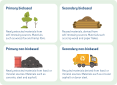
Resource use and a circular economy focuses on how materials are used as well as the lifecycle of materials or products and waste. What we mean by type of use is explained in the figure below. We distinguish between primary and secondary resource use, and between biobased and non-biobased materials.
Policy
The 'Master of Material Flows' policy was further refined in 2025. The policy focuses on the entire lifecycle of materials in our operations, from design and procurement to construction, management and end-of-life processing. As a result, the policy affects Heijmans' entire value chain.
With this policy, we comply with the Dutch Environmental Management Act and the Soil Quality Decree. The policy has also been drawn up in line with the frameworks and guidelines set out in the Raw Materials Agreement and the national ambition to achieve a fully circular economy by 2050.
We are focusing on making non-biobased material flows more sustainable and using biobased material flows. In addition, waste streams are managed responsibly by paying attention to separation and recycling in order to minimise the number of waste streams that are sent to landfill or incinerated. However, the negative impact of the residual flows from our operations is small compared to the negative impact arising from our material inflows. Heijmans’ ambition therefore focuses primarily on reducing the negative impact of material inflows by reducing primary non-biobased material inputs, promoting high-quality recycling and encouraging the reuse of released materials.
This policy is made available to internal stakeholders who are responsible for translating actions and guidelines into their business areas. Such internal stakeholders include sustainability managers, sustainability advisors and management of the holding and business areas.
Resource flows
Our policy covers all resource flows within our own operations, all Heijmans business areas and the entire value chain. In this sustainability statement, the reporting and associated actions and indicators focus on limiting the negative impact of resource inflows.
From this perspective, a study looked at the most demanding and most used resource flows within Heijmans' operations. This selection was made based on the following criteria: expenditure on the material inflow, the environmental impact associated with the material inflow, the mass representing the resource inflow, and the strategic importance of the resource inflow. The results of the study have pointed us towards four significant resource flows: asphalt, concrete, steel and wood.
Reducing primary resource use
By investing in renovation projects and management and maintenance projects, we contribute to extending the lifespan of existing infrastructure and buildings. This commitment leads to increased efficiency and utilisation of the built environment over its lifetime. This also contributes to reducing the use of resources in our operations, while we reduce the use of resources to meet the housing, infrastructure and non-residential demand in the Netherlands. This policy encourages a more sustainable earnings model, where longer and better use can be made of existing buildings and infrastructure.
We are also focusing on innovative solutions to reduce the use of resources, such as hollow concrete piles to reduce the use of concrete. We do this by making solid concrete piles hollow, meaning less concrete is needed for the same output. Another example is Recoflex, an innovative solution for managing and maintaining roads and cycle paths. Recoflex allows existing roads to be used as foundations, which means less asphalt needs to be used. This is made possible because only one layer of Recoflex is applied, as opposed to the traditional approach where the entire road surface needs to be replaced.
Use of secondary resources
Another component of the policy focuses on replacing primary resources with secondary resources. Construction is characterised as a resource-intensive industry. It will therefore be necessary to continue building given the current demand for housing and infrastructure. It is important, however, not only to make better use of existing buildings, but also to reduce the negative impact of our use of materials. By using more secondary resources, processes with a high environmental impact such as the extraction or transformation of raw materials can be avoided. Furthermore, this would also reduce the pressure on the future scarcity of raw materials.
A specific example of Heijmans' commitment to the use of secondary resources is our cooperation with a concrete supplier. On the one hand, we finance secondary concrete purchases from this partner in order to provide financial scope for innovation, which increases access to the secondary use of materials. On the other hand, we offer the same supplier access to our concrete outflows. By actively targeting these outflows, we increase the availability of secondary materials in the value chain and encourage circular material flows and earnings models. Other examples are described in the section ‘Circular applications’ in the Management Report.
Use of biobased materials
The use of sustainable biobased materials, such as wood or hemp fibre, is a focal point for Heijmans. These materials can be recovered time and time again and can replace primary, non-biobased material flows when applied. Heijmans is therefore committed to increasing the use of biobased materials. One way to achieve this is by developing more timber-frame homes with a high proportion of timber use.
A major advantage of developing timber-framed houses and using wood is that wood can replace environmentally harmful materials such as concrete. Wood also contributes to the long-term storage of CO2, allowing Heijmans to not only reduce the impact of the use of materials, but also achieve a positive impact on climate change. A detailed explanation of this initiative can be found in the section 'greenhouse gas removals’ in the ‘Climate’ chapter.
The use of wood also comes with the downside that it leads to deforestation, a large-scale loss of biodiversity, and CO2 emissions from changes to land use. As a result, Heijmans has adopted a policy of purchasing only FSC- or PEFC-certified wood.
Cross-overs with other topics
The use of resources and the circular economy affect all of Heijmans' sustainability pillars to some extent. The relationship between circular solutions and the impact on climate, water and biodiversity is unclear. These environmental impacts are determined in lifecycle analyses (LCAs). As part of Heijmans' strategic approach, the impact of the use of resources is assessed separately for each topic (Climate, Water and Biodiversity), with Climate proving the key topic. No separate actions are defined in this policy plan for Climate, Water or Biodiversity in terms of the environmental performance of resource. This section focuses on the use of materials and the sustainable procurement of resources. The initiatives around Climate, Water and Biodiversity are explained in more detail in the chapters on these specific topics.
Targets
We have not included a central target for the use of materials and the circular economy in 2025, even though this topic represents a high-level goal in our projects. This year, we are reporting on the resource inflows for the first time. The insights gained from this initial reporting, together with the direction set out in the Raw Materials Agreement, form the starting point for establishing a formal target in 2027.
Actions
Heijmans has defined actions for each material flow in order to reduce the negative impact of our use of resources. Each material is unique and can contribute in different ways to reducing the environmental impact of overall material use.
Currently, there is insufficient insight into the resources used to implement the strategy and how progress is monitored.
|
Material flow |
Action |
Explanation |
Value chain |
Time horizon |
|
Asphalt |
AsfaltNu Collaboration |
AsfaltNu is a subsidiary of Heijmans that produces circular asphalt based on recycling within and outside our operations. The asphalt produced by this subsidiary accounts for all the asphalt we use in our operations. |
Across the entire value chain |
Ongoing measure |
|
By focusing on circular asphalt with this measure, we are increasing the use of secondary asphalt and secondary materials. We are also reducing the demand for crushed stone, bitumen and other components that can have a negative impact on the environment. |
||||
|
In 2026, production will start at the newest asphalt plant resulting from this measure, namely the Lage Weide Asphalt Plant, where up to 100% circular asphalt will be produced. This measure contributes to reducing our use of primary materials and the associated negative impact related to primary asphalt use. |
||||
|
Concrete |
Use of secondary sand, gravel and binding agent |
By actively focusing on secondary materials needed for concrete production, we are increasing the share of circular concrete in our operations. This reduces the demand for new materials, binders and energy required for concrete production, thereby reducing the environmental impact of our use of materials. |
Across the entire valure chain |
Ongoing measure |
|
This includes, among other things, the use of secondary sand, gravel and binding agents in the concrete we produce ourselves. In addition, a minimum proportion of secondary raw materials is set on a project-by-project basis for purchased concrete. We work together with concrete suppliers by making agreements on the purchase of circular concrete and by providing access to our concrete waste streams. This gives suppliers the opportunity to use secondary raw materials and contributes to reducing the negative impact of our use of materials. |
||||
|
Steel |
Reuse of released steel products and use of high-quality recycled steel |
By paying more attention to harvesting released steel, we are increasing the proportion of secondary reuse within one of our significant material flows. This focus includes, among other things, using and supporting marketplaces for released steel. We are also actively seeking cooperation with the demolition world to give released steel a place, both in our own projects and outside. At De Nieuwe Post, donor steel from another Heijmans project was used to reduce the primary demand for steel. This measure reduces our primary steel consumption and the associated environmental impact. |
Across the entire value chain |
Ongoing measure |
|
We are also reducing our primary use by actively purchasing high-quality secondary materials and working with suppliers to increase their availability. In this way, we not only support our own circular goals, but also stimulate the secondary steel market. This not only reduces the environmental impact of steel use in our own operations, but also in general. |
||||
|
Wood |
Procurement policy 100% FSC or PEFC certified wood |
By aiming for 100% sustainably sourced timber, we contribute to the resilience of forests worldwide. This policy has been in place at Heijmans for some time now, and our acquired subsidiaries are currently implementing it. |
Upstream |
Ongoing measure |
|
Through this measure, when we use wood to reduce our environmental impact of material, we ensure that our wood use does not have a negative environmental impact. An example of the negative impact of wood is the loss of biodiversity attributable to the extraction of wood from unsustainable forests. |
||||
|
Biobased materials |
Increased use of wood and other sustainable biobased materials |
By taking action on increasing wood and other sustainable biobased materials, such as flax or hemp fibre, our use of environmentally damaging materials such as concrete or plastic decreases. We will also reduce our demand for primary non-biobased materials by using a higher proportion of biobased materials. Through this measure, we reduce the negative impact of our use of materials. |
Own operations |
Ongoing measure |
Metrics
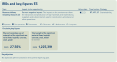
The table shows the total use of Heijmans' significant material inflows. It also shows the amount of secondary or sustainable materials purchased for each material inflow.
|
2025 |
|
|
Asphalt |
|
|
Total weight (in tonnes) |
687,070 |
|
Secondary weight (in tonnes) |
292,900 |
|
% secondary |
42.63% |
|
Concrete |
|
|
Total weight (in tonnes) |
477,921 |
|
Secondary weight (in tonnes) |
24,557 |
|
% secondary |
5.14% |
|
Steel |
|
|
Total weight (in tonnes) |
51,156 |
|
Secondary weight (in tonnes) |
20,232 |
|
% secondary |
39.55% |
|
Wood |
|
|
Total weight (in tonnes) |
9,245 |
|
Sustainably sourced weight (in tonnes) |
7,863 |
|
% sustainably sourced (FSC or PEFC) |
85.05% |
|
Total weight of material |
1,225,391 |
|
Of which secondary |
337,689 |
|
% secondary |
27.56% |
|
Of which biobased |
9,245 |
|
% sustainably sourced |
85.05% |
Reporting requirements
|
Reporting requirements |
KPI definition |
Methodology |
Assumptions |
Limitation |
|
|---|---|---|---|---|---|
|
E5-4 |
31(a) |
Total use of materials. |
The total material weight is based on supplier data and, where this is lacking, on estimates based on expenditure. The method for each material flow is as follows: |
For wood, only the volume is known. The volume is converted to tonnes using the density of reference types of wood. For this, we use the density of Houtinfo.nl. |
When calculating this data point, we are dependent on our suppliers. As a result, in some cases we have to make estimates or use conversion factors to retrieve missing data. This is specified by material stream. |
|
Asphalt |
For the subsidiaries, the data has been extrapolated based on their turnover in relation to that of Heijmans. |
||||
|
The weight is based on actual weighing slips from suppliers. The data is highly reliable. |
|||||
|
Concrete |
|||||
|
The weight is based on queries to the largest suppliers. All expenditure and weights are fully accounted for in these surveys. These surveys cover a quarter of the expenditure. Conversion factors have been determined for the remaining expenditure. The reliability is lower. |
|||||
|
Steel |
|||||
|
The weight is derived from a request for invoices and associated weights from the largest suppliers. These suppliers together cover 41.42% of the total spend. The conversion factors have been applied to the total spend. The reliability is low. |
|||||
|
Wood |
|||||
|
An annual survey is conducted among suppliers. In this survey, we ask the total volumes of timber supplied and the share of sustainable timber. This survey covers the vast majority of the spend. Based on the survey, a conversion factor has been determined for the remaining expenditure. The data is reliable. |
|||||
|
31(b) |
The percentage of sustainably sourced biobased material. |
The total weight of sustainably sourced timber is calculated on the basis of the information requested from our timber suppliers, whereby each supplier is checked to see whether it has FSC or PEFC certification. Based on the amount of sustainably sourced timber, a percentage for the whole is determined. |
We receive the volumes, which are converted to weight using the density of reference types of wood. For this, we use the density of Houtinfo.nl. |
When calculating this data point, we are dependent on our suppliers. As a result, in some cases we have to make estimates or use conversion factors to retrieve missing data. This is specified by material stream. |
|
|
This data point only applies to biobased materials, so it does not apply to asphalt, concrete and steel. |
For subsidiaries, a percentage of 0% has been included due to missing data. |
||||
|
Reporting requirements |
KPI definition |
Methodology |
Assumptions |
Limitation |
|
|---|---|---|---|---|---|
|
31(c) |
The weight both in absolute value and percentage of secondary use of materials in the company. |
The weight of secondary material in asphalt is determined on the basis of the corresponding mixture codes. |
For the subsidiaries, the data has been extrapolated based on their turnover in relation to that of Heijmans. |
When calculating this data point, we are dependent on our suppliers. This means that in some cases we have to use market figures to retrieve missing data. This is specified by material stream. |
|
|
Total and percentage use of secondary material shows the weight in kilograms of secondary material flows within the financial year compared to total use of materials. |
For concrete, the proportion of secondary material is calculated using supplier information and, where this is not available, the market average is used. |
||||
|
For steel, the proportion of secondary material is calculated using product cards for steel types; steel purchases are assigned to reference steel types. |
|||||
|
For wood, the proportion of secondary material is not relevant. Sustainable forest management is pursued, which means that wood is renewable and already contributes fully to reducing the proportion of primary abiotic use of materials. If wood is recycled or reused within Heijmans' processes, this is not included. |
|||||