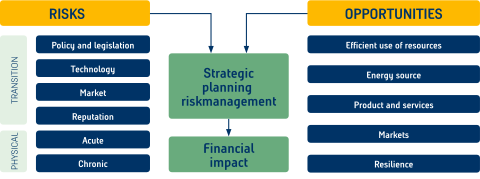
The TCFD (Taskforce on Climate-related Financial Disclosure), is a framework for the financial sector to include the impact of climate change in the assessment of business processes. The framework was created with the aim of identifying potential impacts of climate change on primary business processes. Heijmans uses it to provide insight, in conjunction with our CO₂ footprint, for example, into the impact of climate change on our business operations.
|
Type |
Subject |
# |
Climate-related risk |
Relevance to Heijmans |
|
|
Transition |
Policy and legislation |
1 |
Higher price for GHG emissions |
M |
Will eventually become visible in the charging on of purchased products |
|
2 |
Improved emissions reporting obligations |
M |
Heijmans already reports according to standards |
||
|
3 |
Increasing greenhouse gas emission limitation regulations |
H |
Directly visible when purchasing new equipment and additional requirements local councils in construction projects |
||
|
4 |
Mandates for and regulation of existing products and services |
M |
Part of regular tenders |
||
|
5 |
Exposure to lawsuits |
L |
Heijmans is one of the frontrunners so risks are lower, management systems and certifications are in place |
||
|
Technology |
6 |
Replacement of existing products and services with lower-emission options |
L |
New technologies are already part of our designs |
|
|
7 |
Failure to invest successfully in new technologies |
M |
Heijmans wants to be at the forefront in terms of equipment procurement. Part of investment monitoring |
||
|
8 |
Cost of switching to lower emission technology |
H |
Emission-free construction requires relatively heavy investment in new equipment |
||
|
Market |
9 |
Changing client behaviour |
L |
Heijmans is in a position to respond to changing demands |
|
|
10 |
Uncertainty in market signals |
M |
Firm commitment by public sector market, but uncertainty on regulatory issues |
||
|
11 |
Higher costs of raw materials |
H |
In particular due to passing on of CO₂ pricing and longer supply routes |
||
|
12 |
Declining availability of raw materials |
M |
Not necessarily related to climate risks |
||
|
Reputation |
13 |
Shifts in consumer preferences |
L |
Heijmans' designs can meet demand |
|
|
14 |
Stigmatisation of the sector |
L |
Many initiatives and appreciation apparent |
||
|
15 |
Increased stakeholder concerns or negative feedback from stakeholders |
L |
Good contact with stakeholders |
|
Type |
Subject |
# |
Climate-related risk |
Relevance to Heijmans |
|
|
Physical |
Acute |
16 |
Extreme river water levels |
M |
Previous situations managed logistically, though possible price risk and higher insurance costs |
|
17 |
Increase in heavy rainfall |
M |
Water damage to structures is still relatively limited, but does affect the construction process |
||
|
18 |
Increasing number of heatwaves |
L |
Relevant for employability of employees and continuity of projects, can be managed with measures |
||
|
19 |
Increase in forest fires |
L |
Affects natural areas more than built environment |
||
|
20 |
Increasing winds and storms |
M |
Damage to building sites and buildings due to windstorms (usually insurable) |
||
|
Chronic |
21 |
changes in rainfall patterns and extreme variability in weather patterns |
L |
Measures frequently possible in the long term |
|
|
22 |
Rising sea levels |
L |
Permits awarded for construction in certain areas |
||
|
23 |
Rising average temperatures |
L |
Measures possible in design and required in regulations |
||
|
24 |
Changing ecosystems (including biodiversity) |
L |
No relevant impact on direct business operations, but does represent an opportunity for service delivery. Emergence of persistent exotic species |
|
Type |
# |
Climate-related opportunity |
Relevance to Heijmans |
|
|
Efficient use of resources |
1 |
Use of more efficient modes of transport and production and distribution processes |
M |
Attention for industrialisation and sustainable mobility |
|
2 |
Use of recycling |
M |
Gets a lot of attention in talks with supplying companies |
|
|
3 |
Switching to more efficient buildings |
H |
Essential part of design new buildings |
|
|
4 |
Reduced water use and consumption |
L |
So far less relevant in Dutch context |
|
|
Energy source |
5 |
Use of lower-emission energy sources |
H |
Application of products and services in the built environment, such as development of electricity grid and underground infrastructure |
|
6 |
Use of supportive policy incentives |
M |
Part of business cases, use of subsidies |
|
|
7 |
Use of new technologies |
M |
Standardisation of application of heat pump technologies and alternative services |
|
|
8 |
Participation in CO2 market |
L |
So far no business models that can convert energy savings into carbon credits |
|
|
9 |
Shift to decentralised power generation |
H |
Many solutions available for individual homes and neighbourhood clusters |
|
Type |
# |
Climate-related opportunity |
Relevance to Heijmans |
|
|
Products and services |
10 |
Development and/or expansion of low-emission goods and services |
H |
Both in home and building designs and energy supply. Opportunities through network expansion (electricity, hydrogen) |
|
11 |
Development of climate adaptation and insurance risk solutions |
H |
Mainly the construction of embankments, modification of innwer-city sewage systems and water storage |
|
|
12 |
Development of new products or services through R&D and innovation |
M |
Heijmans' role is system integrator and launching customer rather than innovator |
|
|
13 |
Potential to diversify business activities |
M |
Mostly expansion of existing products and services |
|
|
14 |
Shift in consumer preferences |
H |
Opportunity to provide clients with sustainable solutions |
|
|
Markets |
15 |
Access to new markets |
H |
Mainly the energy market, development, management and maintenance of systems/lines |
|
16 |
Use of government incentives |
H |
Contribution to investments in sustainable equipment and renewable energy systems, often indirectly (renovation) |
|
|
Resilience |
17 |
Participation in renewable energy programmes and adoption of energy efficiency measures |
H |
Various participations (see also overview Green Deals and partnerships in appendix 20.6.4) |
|
18 |
Substitution/diversification of resources |
M |
Switch from gas to electricity, particularly in the renovation market |
|
|
19 |
Green financing |
M |
There are opportunities but often not decisive for the business case |
L = Low risk/opportunity M = Medium risk/opportunity H = High risk/opportunity